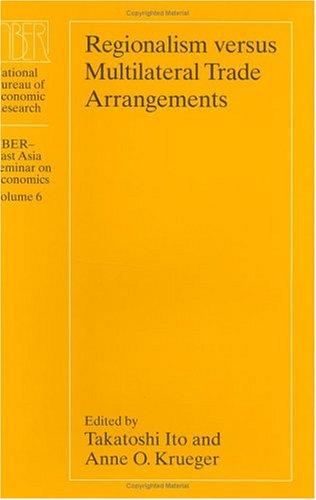
Regionalism versus multilateral trade arrangements
0
0
As an Amazon Associate and affiliate partner, Menrva Books earns from qualifying purchases. Learn more
Author Description
There is no doubt that after World War II the open multilateral trading system was a key ingredient in the rapid economic development of the entire world. Especially in Hong Kong, Korea, Singapore, and Taiwan, exports increased dramatically both in absolute terms and as a percentage of GNP. In the 1980s, however, preferential trading arrangements (PTAs) began to emerge as significant factors affecting world trade. This volume contains thirteen papers that analyze the tensions between multilateral trading systems and preferential trade arrangements and the impact of these tensions on East Asia.
Menrva's Summary
THE THESIS
The book investigates the growing tension between the established multilateral trading system and the rise of preferential trade arrangements (PTAs) and their specific impact on East Asia. The volume presents thirteen papers analyzing how these competing trade frameworks have influenced global commerce, particularly in rapidly developing East Asian economies like Hong Kong, Korea, Singapore, and Taiwan, which saw significant export growth under the post-World War II multilateral system. The analysis explores the economic consequences and strategic implications of this shift towards regionalism.
THE SCOPE MAP
- Analysis of the post-World War II open multilateral trading system and its role in global economic development.
- Examination of the dramatic export increases in East Asian economies (Hong Kong, Korea, Singapore, Taiwan) as a percentage of GNP.
- Detailed study of the emergence and impact of preferential trading arrangements (PTAs) in the 1980s.
- Exploration of the tensions between multilateralism and regionalism in international trade.
- Case studies focusing on the specific effects of these trade dynamics on East Asia.
- Economic analysis of how PTAs affect global trade patterns.
- Discussion of the strategic implications of regional trade blocs versus global agreements.
THE AUTHORITY PERSPECTIVE
This volume, published in 1997, likely offered a timely analysis of trade policy shifts during a period of increasing regionalization. The collection of papers suggests a focus on economic theory and empirical data relevant to international trade and development economics. The focus on East Asia indicates an interest in the economic transformations occurring in that region during the late 20th century. The book's contribution would be in dissecting the complex interplay between global trade structures and emerging regional pacts.
Page Count:
419
Publication Date:
1997-01-01
ISBN-10:
0226386724
Non-Fiction
Economics
Trade Policy
International relations
Community Tags
Similar Books