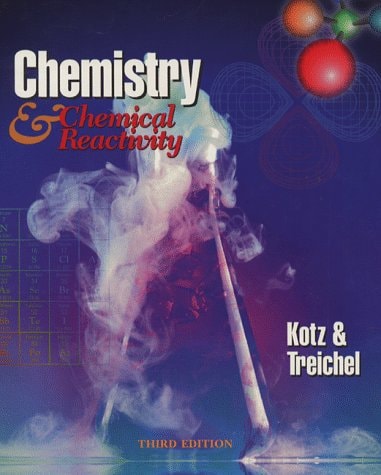
Chemistry and Chemical Reactivity
0
0
As an Amazon Associate and affiliate partner, Menrva Books earns from qualifying purchases. Learn more
Author Description
Chemistry & Chemical Reactivity is organised in two ways. First, there are chapters on the Principles of Reactivity, and others on Bonding and Molecular Structure that are especially important in carrying the themes of the book. The chapters on Principles of Reactivity introduce you to the factors involved in chemical reactions that lead to the successful production of products. Thus, under this topic you will study common types of reactions, the energy involved in reactions, and the factors that affect the speed of a reaction. The principles of Bonding and Molecular Structure are particularly important. If you page through the book, you will notice the abundance of molecular models, some drawn by George Kelvin, our principal artist for this edition, and others drawn with a computer. As described in several places in the book (An Introduction - The Nature of Chapter 3: Buckyballs, AIDS, and Chemistry, and Chapter 9: Computer Molecular Modelling) an understanding of molecular structures is one cornerstone of modern chemistry. Using the latest laboratory techniques for uncovering molecular structures and computer programs that generate revealing portraits of structures, chemists have enormous insight into the ways molecules react. Second, the book is also divided roughly into five sections, each with a grouping of chapters with a common Part 1: The Basic Tools of Chemistry, Part 2: The Structure of Atoms and Molecules, Part 3: States of Matter, Part 4: The Principles of Reactivity and Part 5: The Chemistry of the Elements and Their Compounds.
Menrva's Summary
THE THESIS
This text investigates the fundamental principles of chemical reactivity and the relationship between molecular structure and chemical behavior. John C. Kotz utilizes a structured pedagogical approach to explain how atomic and molecular configurations dictate the outcomes of chemical reactions. By integrating modern laboratory techniques and computer-generated molecular modeling, the text provides a framework for understanding the mechanisms that govern the production of chemical products.
THE SCOPE MAP
What You Will Find
- Principles of Reactivity including reaction types, energy dynamics, and reaction kinetics
- Bonding and Molecular Structure analysis
- Five-part organizational structure covering basic tools, atomic structure, states of matter, reactivity principles, and elemental chemistry
- Visual aids including computer-generated molecular models and artistic renderings
Scope Limits
- Advanced specialized sub-disciplines such as complex organometallic synthesis or advanced quantum field theory
- Historical development of chemical theory beyond its immediate application to current models
THE AUTHORITY PERSPECTIVE
Experts and educators frequently cite this text as a comprehensive resource for undergraduate chemistry students due to its clear organizational structure. Readers often note the balance between theoretical principles and the practical application of molecular modeling in modern laboratory settings.
Page Count:
0
Publication Date:
1997-01-01
Publisher:
Henry Holt & Company
ISBN-10:
0030159245
ISBN-13:
9780030159244
Science
textbook
Physical Chemistry
Academic
Inorganic Chemistry
Chemistry
Community Tags
Other Editions(4)

Similar Books











Reader Comments
Share Your Thoughts
No comments yet. Be the first to share your thoughts!