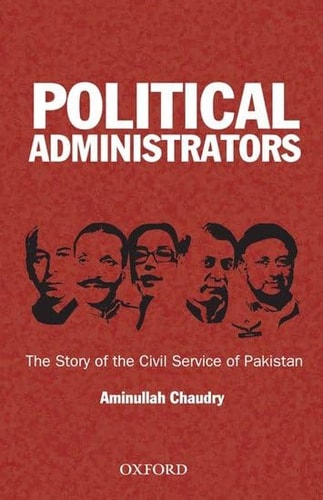
Political Administrators: The Story of the Civil Service of Pakistan
0
0
As an Amazon Associate and affiliate partner, Menrva Books earns from qualifying purchases. Learn more
Author Description
About the AuthorAminullah Chaudry joined the Civil Service of Pakistan in 1967, and has worked as District Magistrate, Divisional Commissioner and Provincial Secretary in the Punjab. He was Secretary to Prime Minister in 1996-97. At the time of the coup on 12 October 1999, he was Director General, Civil AviationAuthority of Pakistan with the additional charge of the Aviation Division in the Ministry of Defence.Product DescriptionIn the sixty-three years since Pakistan's independence, military dictators have ruled for thirty-three. For the remaining thirty, Pakistan had politicians ranging from the autocratic to the corrupt and inept to the clueless. These fluctuations between dictatorship and democracy could have beenabsorbed by a country with a functional and reasonably neutral civil service.Pakistan inherited a well-oiled machine in the form of a bureaucracy that had at its core the Indian Civil Service (ICS). Within no time at all, its successor the Civil Service of Pakistan (CSP) first forged an alliance with the Army and actively undermined the democratic process. After theannihilation of the former in what was then East Pakistan in 1971, the bureaucracy aligned itself with Zulfikar Ali Bhutto and after the coup of 1977 put all its weight behind Gen. Ziaul Haq. This flip-flop continued through the so-called democratic regimes of Benazir Bhutto and Nawaz Sharif and thedictatorship of Gen Pervez Musharraf.The institutional rot occasioned by these shenanigans did incalculable and perhaps irreversible harm to the civil service in Pakistan. The ability of this institution to deliver was seriously undermined. In sharp contrast, neighbor India which inherited the same structure, successfully adapted it tomeet the demands of a democratic order. In Pakistan the crumbling structure of the civil service has been highlighted by political analysts and academicians, but rarely by an individual from within. As and when civil servants have written, they have made an unsuccessf
Menrva's Summary
THE THESIS
This book investigates the institutional decline of the Civil Service of Pakistan and its role in the nation's political instability since independence. Aminullah Chaudry, a veteran civil servant who served in various high-level administrative and governmental roles, utilizes his firsthand experience to analyze the bureaucracy's shift from a functional colonial inheritance to a compromised political instrument. He argues that the service's repeated alignment with military dictators and shifting political regimes fundamentally eroded its capacity to serve the public interest.
THE SCOPE MAP
What You Will Find
- A historical analysis of the transition from the Indian Civil Service to the Civil Service of Pakistan.
- Examination of the bureaucratic alliances with military regimes, including the eras of Ziaul Haq and Pervez Musharraf.
- Comparative insights regarding the divergent paths of the civil services in Pakistan and India.
- First-person accounts of administrative operations during critical periods of Pakistani political history.
THE AUTHORITY PERSPECTIVE
Experts and political analysts highlight this work as a rare, insider critique of Pakistan's administrative machinery. Readers frequently note that the author provides a necessary, grounded perspective that distinguishes this account from purely academic or external observations of the region's governance.
Page Count:
350
Publication Date:
2011-01-01
Publisher:
Oxford University Press
ISBN-10:
0199061718
ISBN-13:
9780199061716
Biography
History
Pakistan
Civil Service
Government
Public Administration
Community Tags
Similar Books