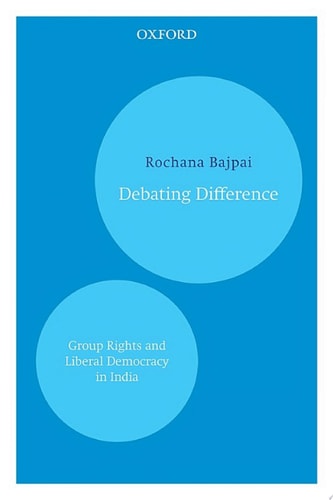
Debating Difference: Group Rights and Liberal Democracy in India
0
0
As an Amazon Associate and affiliate partner, Menrva Books earns from qualifying purchases. Learn more
Author Description
India is an outstanding example of multiculturalism, with wide-ranging policies of group preference dating back to the colonial period. Debating Difference presents the first systematic account of the structure of public reasoning over group rights primarily focusing on the landmark constitutional and legislative debates in the late 1940s and late 1980s. While the former saw a centralization of power, the latter marked a decentering of power in the Indian polity. Dr. Rochana Bajpai focuses, exclusively, on shifts in political discourses, even as she simultaneously illuminates the political events and junctures in which these are located. Through an analytical interpretation of the Constituent Assembly (1946-9), Shah Bano (1986), and Mandal (1990, 2006) debates, Debating Difference constructs a conceptual framework within which Indian arguments over group rights can be understood and evaluated. It argues that the interplay between five principal ideals--secularism, democracy, social justice, national unity, and development--has framed political debate in India.
Menrva's Summary
THE THESIS
This book investigates how the conceptual framework of public reasoning in India has shaped the evolution of group rights and multicultural policy within a liberal democratic state. Dr. Rochana Bajpai, a scholar of Indian politics, utilizes a comparative analysis of landmark legislative and constitutional debates to map the shifting political discourse from the late 1940s to the early 21st century. By examining the interplay of five core ideals—secularism, democracy, social justice, national unity, and development—the author provides a rigorous analytical structure for understanding how power has been centralized and decentered in the Indian polity over several decades.
THE SCOPE MAP
What You Will Find
- A systematic analysis of the Constituent Assembly debates (1946-1949).
- An examination of the Shah Bano (1986) and Mandal (1990, 2006) legislative controversies.
- A conceptual framework identifying the five primary ideals governing Indian political discourse.
- A historical study of the transition from colonial-era group preference policies to modern democratic governance.
THE AUTHORITY PERSPECTIVE
Scholars and political scientists recognize this work as a foundational text for understanding the intellectual history of Indian multiculturalism. Readers frequently note the academic density of the prose, which provides a sophisticated, nuanced look at the intersection of political theory and historical legislative practice.
Page Count:
312
Publication Date:
2011-01-01
Publisher:
OUP India
ISBN-10:
0199088233
ISBN-13:
9780199088232
Politics
History
Democracy
Kindle Store
World politics
Specific Topics
Asia
Ethnic relations
Kindle eBooks
India
Law
Minorities india
Categories
Pakistan
Sociology
Civil Rights
Community Tags
Similar Books