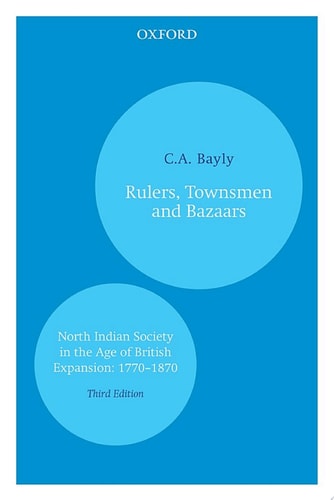
Rulers, Townsmen and Bazaars: North Indian Society in the Age of British Expansion, 1770–1870
0
0
As an Amazon Associate and affiliate partner, Menrva Books earns from qualifying purchases. Learn more
Author Description
This path-breaking work on the social and economic history of colonial India traces the evolution of North Indian towns and merchant communities from the decline of Mughal dominion to the consolidation of British empire following the 1857 'mutiny'. C.A. Bayly analyses the response of the inhabitants of the Ganges Valley to the upheavals in the eighteenth century that paved the way for the incoming British. He shows how the colonial enterprise was built on an existing resilient network of towns, rural bazaars, and merchant communities; and how in turn, colonial trade and administration were moulded by indigenous forms of commerce and politics. This edition comes with a new introduction.
Menrva's Summary
THE THESIS
This work investigates how the transition from Mughal rule to British colonial administration in North India was mediated by existing indigenous social and economic structures. C. A. Bayly, a distinguished historian of South Asia, utilizes extensive archival research and regional economic data to challenge the notion that British rule was imposed upon a vacuum. He argues that the resilience of merchant communities and the established network of towns in the Ganges Valley fundamentally shaped the nature of colonial expansion and trade between 1770 and 1870.
THE SCOPE MAP
What You Will Find
- Analysis of the socio-economic transition in the Ganges Valley from 1770 to 1870.
- Examination of the interaction between indigenous merchant networks and colonial administrative policies.
- Case studies focusing on the evolution of urban centers and rural bazaar economies.
- Evaluation of the political and commercial continuity between the late Mughal period and the early British Empire.
THE AUTHORITY PERSPECTIVE
Scholars frequently cite this text as a foundational study for understanding the complexities of colonial economic integration in India. Experts highlight the author's meticulous use of primary sources to demonstrate how local agency influenced the trajectory of imperial governance.
Page Count:
552
Publication Date:
2012-01-01
Publisher:
OUP India
ISBN-10:
019908873X
ISBN-13:
9780199088737
History
Economic History
India
Categories
Kindle Store
Kindle eBooks
Colonial History
Social History
Asia
Community Tags
Similar Books