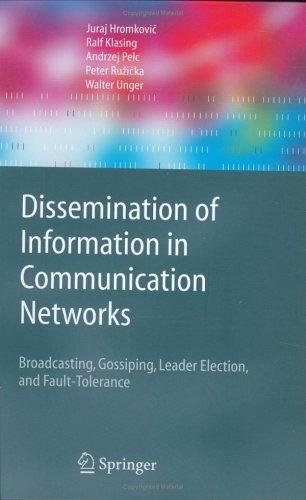
Dissemination of information in communication networks
0
0
As an Amazon Associate and affiliate partner, Menrva Books earns from qualifying purchases. Learn more
Author Description
Preface Due to the development of hardware technologies (such as VLSI) in the early 1980s, the interest in parallel and distributive computing has been rapidly growingandinthelate1980sthestudyofparallelalgorithmsandarchitectures became one of the main topics in computer science. To bring the topic to educatorsandstudents,severalbooksonparallelcomputingwerewritten. The involvedtextbook“IntroductiontoParallelAlgorithmsandArchitectures”by F. Thomson Leighton in 1992 was one of the milestones in the development of parallel architectures and parallel algorithms. But in the last decade or so the main interest in parallel and distributive computing moved from the design of parallel algorithms and expensive parallel computers to the new distributive reality – the world of interconnected computers that cooperate (often asynchronously) in order to solve di?erent tasks. Communication became one of the most frequently used terms of computer science because of the following reasons: (i) Considering the high performance of current computers, the communi- tion is often moretime consuming than the computing time of processors. As a result, the capacity of communication channels is the bottleneck in the execution of many distributive algorithms. (ii) Many tasks in the Internet are pure communication tasks. We do not want to compute anything, we only want to execute some information - change or to extract some information as soon as possible and as cheaply as possible. Also, we do not have a central database involving all basic knowledge. Instead, wehavea distributed memorywherethe basickno- edgeisdistributedamongthelocalmemoriesofalargenumberofdi?erent computers. The growing importance of solving pure communication tasks in the - terconnected world is the main motivation for writing this book.
Menrva's Summary
THE THESIS
The central problem addressed is the increasing bottleneck of communication in distributed computing systems. As hardware technology advanced, the focus shifted from parallel processing within single machines to the interconnectedness of multiple computers. The book argues that communication capacity is now often the limiting factor in executing distributed algorithms, and that many internet tasks are primarily communication-based, requiring efficient information dissemination across distributed memories.
THE SCOPE MAP
- Analysis of communication as a bottleneck in distributed algorithms.
- Discussion of pure communication tasks in the internet.
- Exploration of distributed memory architectures.
- Methods for efficient information dissemination in networks.
THE AUTHORITY PERSPECTIVE
This book appears to be a technical text aimed at an academic audience, likely graduate students and researchers in computer science. Its focus on the practical limitations of communication in modern distributed systems suggests it provides a detailed, perhaps theoretical, examination of network performance and algorithm design. The preface indicates a motivation to update the field from earlier parallel computing paradigms to the current reality of interconnected systems.
Page Count:
361
Publication Date:
2005-01-01
ISBN-10:
3540008462
ISBN-13:
9783540008460
Science
Non-Fiction
Science & Technology
Computer Science
Algorithms
Distributed Systems
Computer Networks
Community Tags
Similar Books