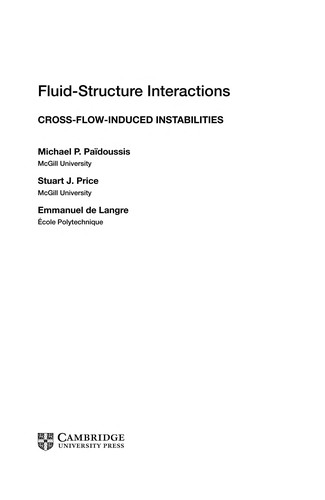
Fluid-structure interactions
0
0
As an Amazon Associate and affiliate partner, Menrva Books earns from qualifying purchases. Learn more
Author Description
Structures in contact with fluid flow, whether natural or man-made, are inevitably subject to flow-induced forces and flow-induced vibration: from plant leaves to traffic signs and to more substantial structures, such as bridge decks and heat exchanger tubes. Under certain conditions the vibration may be self-excited, and it is usually referred to as an instability. These instabilities and, more specifically, the conditions under which they arise are of great importance to designers and operators of the systems concerned because of the significant potential to cause damage in the short term. Such flow-induced instabilities are the subject of this book. In particular, the flow-induced instabilities treated in this book are associated with cross-flow, that is, flow normal to the long axis of the structure. The book treats a specific set of problems that are fundamentally and technologically important: galloping, vortex-shedding oscillations under lock-in conditions, and rain-and-wind-induced vibrations, among others. The emphasis throughout is on providing a physical description of the phenomena that is as clear and up-to-date as possible--Provided by publisher.
Menrva's Summary
THE THESIS
Structures interacting with fluid flow are susceptible to flow-induced forces and vibrations, ranging from everyday objects to critical engineering components. The book addresses instabilities that arise when fluid flow is normal to the long axis of a structure, a phenomenon of significant concern for designers due to its potential for rapid damage. It focuses on specific, technologically important instabilities such as galloping, vortex-shedding oscillations under lock-in conditions, and rain-and-wind-induced vibrations, aiming to provide clear and current physical explanations.
THE SCOPE MAP
- Analysis of flow-induced forces and vibrations on structures.
- Detailed examination of self-excited vibrations and instabilities.
- Focus on cross-flow phenomena (flow normal to the structure's long axis).
- In-depth treatment of galloping, vortex-shedding oscillations (lock-in), and rain-and-wind-induced vibrations.
- Emphasis on providing clear and up-to-date physical descriptions of these phenomena.
- Relevance to designers and operators of systems involving fluid-structure interaction.
THE AUTHORITY PERSPECTIVE
This book is recognized as a specialized text for engineers and researchers dealing with fluid-structure interactions. Its focus on specific instability phenomena like galloping and vortex shedding suggests a detailed, technical approach. The publisher's description highlights its importance for designers concerned with preventing damage caused by flow-induced vibrations. The material presented is likely to be dense and aimed at a readership with a strong background in physics and engineering.
Page Count:
414
Publication Date:
2011-01-01
ISBN-10:
0511860595
ISBN-13:
9780511860591
Non-Fiction
Science
Action
Engineering
Physics
Fluid dynamics
Community Tags
Similar Books