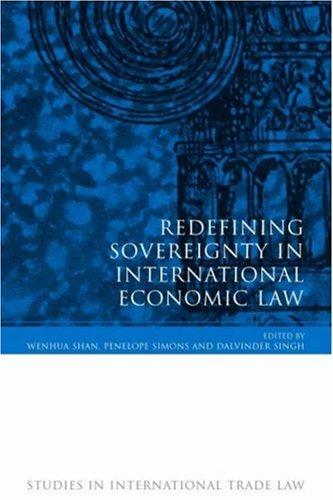
Redefining Sovereignty in International Economic Law
0
0
As an Amazon Associate and affiliate partner, Menrva Books earns from qualifying purchases. Learn more
Author Description
The concept of state sovereignty is increasingly challenged by a proliferation of international economic instruments and major international economic institutions. States from both the south and north are re-examining and debating the extent to which they should cede control over their economic and social policies to achieve global economic efficiency in an interdependent world. International lawyers are seriously rethinking the subject of state sovereignty, in relation to the operation of the main international economic institutions, namely the WTO, the World Bank and the International Monetary Fund (IMF). The contributions in this volume, bringing together leading scholars from the developed and developing worlds, take up the challenge of debating the meaning of sovereignty and the impact of international economic law on state sovereignty. The first part looks at the issues from the perspectives of general international law, international economic law and legal theory. Part two discusses the impact of trade liberalisation on the sovereignty of both industrialised and developing states and Part three concentrates on the challenge to state sovereignty created by the proliferation of investment treaties and the significant recent growth of investment treaty based arbitration cases. Part four focuses on the domestic and international effects of international financial intermediaries and markets. Part five explores the tensions and intersections between the international regulation of trade and investment, international human rights and state sovereignty.--Bloomsbury Publishing.
Menrva's Summary
THE THESIS
The proliferation of international economic instruments and institutions increasingly challenges the traditional concept of state sovereignty. This volume examines how states, both in the Global South and North, are re-evaluating the extent to which they should cede economic policy control for global efficiency. Leading scholars from diverse backgrounds debate the evolving meaning of sovereignty in the face of international economic law and major institutions like the WTO, World Bank, and IMF. The book explores the impact of trade liberalization, investment treaties, arbitration, financial markets, and the intersections with international human rights.
THE SCOPE MAP
- Analysis of sovereignty from the perspectives of general international law, international economic law, and legal theory.
- Discussion on the impact of trade liberalization on the sovereignty of industrialized and developing states.
- Examination of the challenges to state sovereignty posed by investment treaties and arbitration.
- Focus on the domestic and international effects of international financial intermediaries and markets.
- Exploration of the tensions between international regulation of trade and investment, international human rights, and state sovereignty.
THE AUTHORITY PERSPECTIVE
This collection of scholarly contributions addresses a critical and evolving area of international law and economics. The work is structured to provide a comprehensive overview of the challenges to state sovereignty in the contemporary global economic landscape. By bringing together diverse perspectives from leading scholars, the volume offers a nuanced debate on the meaning and impact of international economic law on national autonomy. The multi-part structure ensures a thorough exploration of trade, investment, finance, and human rights in relation to sovereignty.
Page Count:
256
Publication Date:
2008-01-01
ISBN-10:
1841137014
ISBN-13:
9781841137018
Non-Fiction
Politics
Economics
International Law
Community Tags
Similar Books