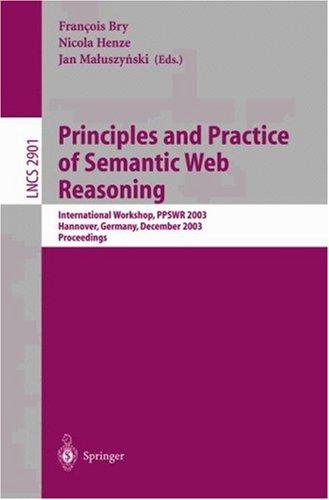
Principles and Practice of Semantic Web Reasoning
0
0
As an Amazon Associate and affiliate partner, Menrva Books earns from qualifying purchases. Learn more
Author Description
The Semantic Web is a major endeavor aimed at enriching the existing Web withmetadataandprocessingmethodssoastoprovideWeb-basedsystemswith advanced(so-calledintelligent)capabilities,inparticularwithcontext-awareness and decision support. The advanced capabilities striven for in most Semantic Web application s- narios primarily call for reasoning. Reasoning capabilities are o?ered by exi- ing Semantic Web languages, such as BPEL4WS, BPML, ConsVISor, DAML-S, JTP, TRIPLE, and others. These languages, however, were developed mostly from functionality-centered (e.g., ontology reasoning or access validation) or application-centered (e.g., Web service retrieval and composition) perspectives. A perspective centered on the reasoning techniques (e.g., forward or backward chaining, tableau-like methods, constraint reasoning, etc.) complementing the above-mentioned activities appears desirable for Semantic Web systems and - plications. The workshop on “Principles and Practice of Semantic Web Reas- ing,” which took place on December 8, 2003, in Mumbai, India, was the?rst of a series of scienti?c meetings devoted to such a perspective. JustasthecurrentWebisinherentlyheterogeneousindataformatsanddata semantics, the Semantic Web will be inherently heterogeneous in its reasoning forms.Indeed,anysingleformof reasoningturnsouttobeirrealin theSemantic Web. For example, ontology reasoning in general relies on monotonic negation (for the metadata often can be fully speci?ed), while databases, Web databases, and Web-based information systems call for non-monotonic reasoning (for one would not specify non-existing trains in a railway timetable); constraint reas- ing is needed when dealing with time (for time intervals have to be dealt with), while(forwardand/orbackward)chainingisthereasoningofchoicewhencoping with database-like views (for views, i.e., virtual data, can be derived from actual data using operations such as join and projections).
Menrva's Summary
THE THESIS
The Semantic Web aims to imbue the existing Web with metadata and processing methods to grant Web-based systems advanced capabilities, particularly context-awareness and decision support. The advanced capabilities sought in most Semantic Web applications primarily necessitate reasoning. While existing Semantic Web languages offer reasoning, they often focus on specific functionalities or applications. This book, stemming from a workshop dedicated to reasoning techniques, proposes a perspective centered on these techniques themselves, such as forward or backward chaining, tableau-like methods, and constraint reasoning, to complement existing activities.
THE SCOPE MAP
- An exploration of reasoning techniques relevant to the Semantic Web, including forward/backward chaining, tableau methods, and constraint reasoning.
- Discussion on the heterogeneity of reasoning forms in the Semantic Web, arguing against a single, universal approach.
- Analysis of how different reasoning types are suited to specific Semantic Web tasks, such as ontology reasoning, access validation, and Web service composition.
- Consideration of monotonic and non-monotonic reasoning in the context of Semantic Web data and information systems.
- Examination of constraint reasoning for temporal data and its application in time-interval management.
- Insights from the "Principles and Practice of Semantic Web Reasoning" workshop held in Mumbai, India, on December 8, 2003.
THE AUTHORITY PERSPECTIVE
This work, originating from a 2003 workshop, addresses the critical need for a reasoning-centric perspective in Semantic Web technologies. The text highlights the inherent heterogeneity of reasoning forms required for a robust Semantic Web, moving beyond single-functionality or application-specific approaches. It posits that understanding and applying diverse reasoning techniques, from monotonic to non-monotonic and constraint-based methods, is essential for developing advanced, intelligent Web systems. The book serves as a foundational exploration of these principles and their practical implications.
Page Count:
209
Publication Date:
2004-01-01
ISBN-10:
3540205829
ISBN-13:
9783540205821
Non-Fiction
Science
Science & Technology
Art
Databases
Web Technology
Logic
Computer Science
Community Tags
Similar Books