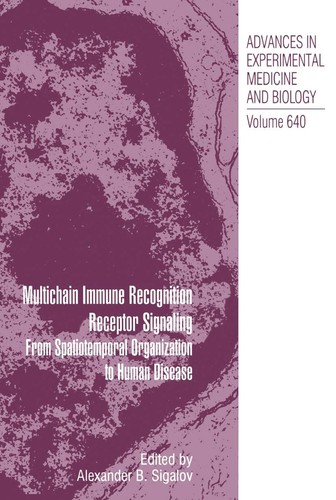
Multichain Immune Recognition Receptor Signaling
0
0
As an Amazon Associate and affiliate partner, Menrva Books earns from qualifying purchases. Learn more
Author Description
The central idea of this book is to show that the structural similarity of the MIRRs determines the general principles underlying MIRR-mediated transmembrane signaling mechanisms and furthermore, provides the basis for existing and future therapeutic strategies targeting MIRRs. This book intends to assemble reviews on the progress in defining and controlling the spatiotemporal organization of key events in immune cell activation. Improved understanding of MIRR-mediated signaling has a number of potential practical applications, from the rational design of drugs and vaccines to the engineering of cells for biotechnological purposes. In Section 1, spatial organization and physiological function of the MIRR family members such as T cell receptor (TCR), B cell receptor (BCR), Fc receptors, natural killer (NK) cell receptors, and platelet glycoprotein VI (GPVI) will be reviewed. Section 2 will focus on current models of MIRR-triggering and highlight modern technologies to visualiz.
Menrva's Summary
THE THESIS
This book posits that the structural similarities among Multichain Immune Recognition Receptors (MIRRs) reveal fundamental principles of transmembrane signaling and inform therapeutic strategies. It aims to consolidate reviews on advancements in understanding and controlling the spatiotemporal organization of immune cell activation events. The improved comprehension of MIRR-mediated signaling holds significant potential for practical applications, including the rational design of drugs and vaccines, as well as the engineering of cells for biotechnological uses. The work is structured to first review the spatial organization and physiological functions of MIRR family members, such as TCR, BCR, Fc receptors, NK cell receptors, and GPVI, before delving into current models of MIRR triggering and modern visualization technologies.
THE SCOPE MAP
- Detailed review of the spatial organization and physiological functions of key MIRR family members (TCR, BCR, Fc receptors, NK cell receptors, GPVI).
- Exploration of current models for MIRR triggering mechanisms.
- Discussion of modern technologies used for visualizing MIRR signaling events.
- Analysis of how structural similarities in MIRRs underpin transmembrane signaling.
- Insights into existing and future therapeutic strategies targeting MIRRs.
- Potential applications in drug and vaccine design.
- Considerations for engineering cells for biotechnological purposes.
THE AUTHORITY PERSPECTIVE
The book is presented as a compilation of reviews focusing on the structural and signaling principles of Multichain Immune Recognition Receptors (MIRRs). Its approach emphasizes the commonalities across different MIRR families to elucidate general signaling mechanisms and therapeutic targets. The content is geared towards researchers and practitioners in immunology, molecular biology, and biotechnology, offering insights into both fundamental science and practical applications. The structure suggests a comprehensive overview for those seeking to understand or manipulate immune cell activation pathways.
Page Count:
357
Publication Date:
2008-01-01
ISBN-10:
0387097880
ISBN-13:
9780387097886
Non-Fiction
Science
Biotechnology
Immunology
Pharmacology
Community Tags
Similar Books