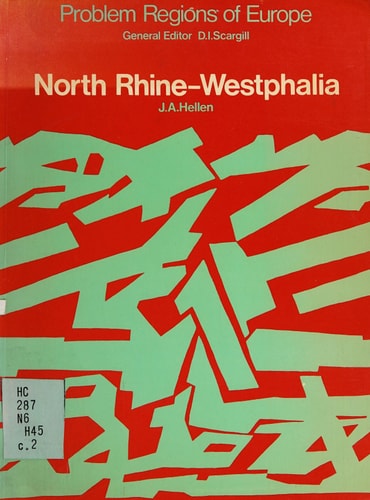
North Rhine-Westphalia
0
0
As an Amazon Associate and affiliate partner, Menrva Books earns from qualifying purchases. Learn more
Author Description
General D. I. Scargill, University of Oxford. Great economic and social changes have taken place in Europe in recent years, and there has been growing consciousness of the need for regional planning. The magnitude, persistence, and areal extent of consequent problems for specific regions seem to justify studies which identify, analyse and even seek solutions to them. The different regions chosen for this series illustrate a variety of problems such as a harsh environment, contraction of agriculture, isolation, industrial decay, urban congestion, or proximity to a sensitive political frontier. One problem of this kind forms the theme for each study but attention has been drawn to similar problems encountered in other parts of the continent and the reader is encouraged to deduce principles of more general application. Introduction; 1 North Rhine-Westphalia in the European Context; The natural framework; The man-made framework; Administration; Economic regions; 2 Legacies from the Past; Agriculture and rural societies; Soil resources; The peasantry; Changes in crops and livestock; Agrarpolitik and agricultural restructuring; The Common Agricultural Policy; The cities and towns; Historical factors; Post-war reconstruction; 3 Contemporary Problems; Coal in decline; Iron and steel; New industries for old; Transport; Problems on the national and European scale; Problems at the local level; Water supply and water pollution; Recreation and countryside conservation; The case of the Rhenish Brown Coalfield; 4 Planning for the Future; North Rhine-Westphalia and the Federal system; North Rhine-Westphalia's development plans; Population increase; Growth poles and axes; The North Rhine-Westphalia Programme 1975; Further Work.
Menrva's Summary
THE THESIS
This study investigates the complex economic, social, and environmental challenges facing North Rhine-Westphalia within the broader context of European regional planning. John A. Hellen, an expert in regional geography, utilizes historical data and contemporary planning documents to analyze how this specific region manages industrial decline, agricultural restructuring, and urban development. The text argues that the region serves as a critical case study for understanding the broader systemic pressures affecting post-industrial landscapes in Europe.
THE SCOPE MAP
What You Will Find
- Analysis of the transition from traditional coal, iron, and steel industries to modern economic sectors.
- Examination of agricultural restructuring and the impact of the Common Agricultural Policy.
- Evaluation of regional development programs, including the North Rhine-Westphalia Programme of 1975.
- Assessment of environmental management issues, specifically water pollution and the Rhenish Brown Coalfield.
THE AUTHORITY PERSPECTIVE
Experts recognize this work as a foundational regional study that provides a detailed snapshot of West German industrial geography during the late 20th century. Readers frequently note the academic density of the prose, which serves as a valuable resource for students of European planning and economic history.
Page Count:
48
Publication Date:
1974-01-01
Publisher:
Oxford Univ Pr
ISBN-10:
019913104X
ISBN-13:
9780199131044
Economics
Germany
Geography
European History
Sociology
Urban Studies
Community Tags
Similar Books