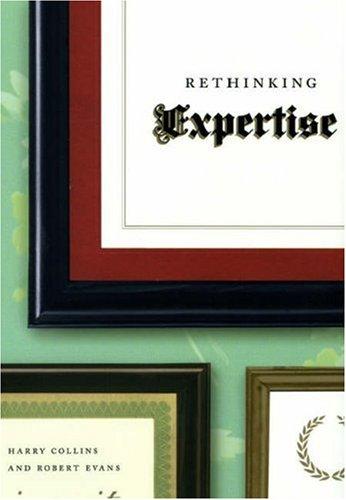
Rethinking Expertise
0
0
As an Amazon Associate and affiliate partner, Menrva Books earns from qualifying purchases. Learn more
Author Description
What does it mean to be an expert? Traditionally, expertise has been associated with authoritative knowledge, honed by practice and certified by powerful institutions. Scientists, of course, are often presumed to be the ultimate experts, but it is exactly in this area that the importance of defining what it means to be an expert is paramount. In Rethinking Expertise, Harry Collins and Robert Evans offer a radical new perspective on the role of expertise in the practice of science and the public evaluation of technology. Collins and Evans present the problem of expertise in the context of modern society and go on to offer a Periodic Table of Expertises based on the idea of tacit knowledge - in other words, knowledge that we have but cannot explain. They then explore how some expertises are used to judge others, how we judge between experts even when we are not experts ourselves, and how credentials are used to judge experts. A central new concept in the book and, the authors argue, in society, is interactional expertise - a proficiency in the language of a specialism if not in its practices. Here, they describe experiments in which people with interactional expertise showed themselves to be indistinguishable from full-fledged experts in imitation games. Throughout, Collins and Evans ask an important question: how can the public make use of science and technology before there is consensus in the scientific community? This is a quandary that has wide implications for public policy and for those who seek to understand and benefit from science. The authors offer a balanced assessment of the main issues and propose a new understanding of how to extend public participation in technical decision-making without abandoning the idea of expertise as real, useful, and necessary. Rethinking Expertise will be of interest to scientists and scholars in science studies but will also have implications for decision makers and experts across many fields - in technology, educati
Menrva's Summary
THE THESIS
This book challenges traditional notions of expertise by proposing a new framework for understanding its role in science and technology evaluation. Harry Collins and Robert Evans argue that expertise is not solely defined by authoritative knowledge or institutional certification, but also by tacit knowledge and the ability to interact with specialized language. They introduce the concept of 'interactional expertise' and explore how it can be used to judge other expertises and inform public decision-making. The authors address the quandary of how the public can engage with science and technology before scientific consensus is reached, offering a new perspective on extending public participation.
THE SCOPE MAP
- What it means to be an expert in modern society
- The concept of tacit knowledge and its role in expertise
- A Periodic Table of Expertises
- How expertises are used to judge other expertises
- The role of credentials in evaluating experts
- Interactional expertise: proficiency in the language of a specialism
- Experiments demonstrating the effectiveness of interactional expertise
- Implications for public policy and public participation in technical decision-making
THE AUTHORITY PERSPECTIVE
Rethinking Expertise is recognized for its significant contribution to the sociology of science and epistemology, offering a novel perspective on the nature and evaluation of expertise. Scholars in science studies and related fields find its framework for understanding tacit and interactional expertise particularly insightful. The book's exploration of how the public can engage with complex scientific and technological issues before consensus is reached is seen as highly relevant for policy makers and those seeking to bridge the gap between scientific communities and the public. Its arguments are considered to have broad implications for how we understand and utilize knowledge in contemporary society.
Page Count:
160
Publication Date:
2007-01-01
ISBN-10:
0226113604
ISBN-13:
9780226113609
Philosophy
Science
Non-Fiction
Epistemology
Sociology of Science
Public Policy
Community Tags
Similar Books