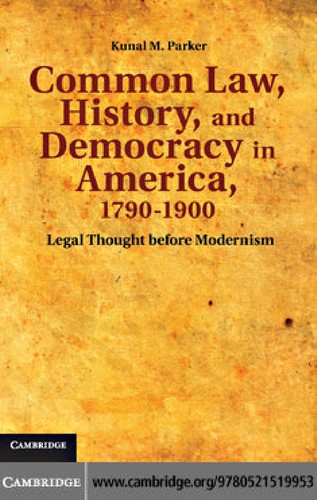
Common Law, History, and Democracy in America, 1790-1900
0
0
As an Amazon Associate and affiliate partner, Menrva Books earns from qualifying purchases. Learn more
Author Description
This book argues for a change in our understanding of the relationships among law, politics and history. Since the turn of the nineteenth century, a certain anti-foundational conception of history has served to undermine law's foundations, such that we tend to think of law as nothing other than a species of politics. Thus viewed, the activity of unelected, common law judges appears to be an encroachment on the space of democracy. However, Kunal M. Parker shows that the world of the nineteenth century looked rather different. Democracy was itself constrained by a sense that history possessed a logic, meaning and direction that democracy could not contravene. In such a world, far from law being seen in opposition to democracy, it was possible to argue that law - specifically, the common law - did a better job than democracy of guiding America along history's path.
Menrva's Summary
THE THESIS
This book challenges the modern view of law as merely a form of politics by re-examining the relationship between common law, democracy, and history in 19th-century America. It argues that a historical understanding prevalent in the 19th century, which perceived history as having an inherent logic and direction, actually supported the role of common law judges. In this context, the common law was seen not as an impediment to democracy, but as a superior guide for the nation's historical trajectory, a perspective that contrasts sharply with contemporary anti-foundational historical conceptions that undermine law's legitimacy.
THE SCOPE MAP
- An analysis of the evolving understanding of law, politics, and history from 1790 to 1900.
- An argument against the contemporary view that common law judges' activities are an encroachment on democracy.
- An exploration of the 19th-century belief in history's inherent logic and direction.
- A re-evaluation of the common law's role in guiding American democracy.
- Examination of the anti-foundational conception of history that emerged around the turn of the 19th century.
- Discussion of how this historical conception influenced the perception of law's foundations.
THE AUTHORITY PERSPECTIVE
The book's central thesis, which posits a different understanding of the relationship between law, politics, and history in 19th-century America, is presented as a significant re-evaluation of established historical and legal thought. By challenging the modern view that law is simply a species of politics and that common law judges' actions are an encroachment on democracy, Parker offers a counter-narrative rooted in the historical consciousness of the period. The work suggests that in the 19th century, a belief in history's guiding logic actually bolstered the legitimacy of the common law as a democratic instrument.
Page Count:
305
Publication Date:
2011-01-01
ISBN-10:
0521519950
ISBN-13:
9780521519953
History
Non-Fiction
Politics
Historiography
American History
Political Theory
Legal History
Community Tags
Similar Books














