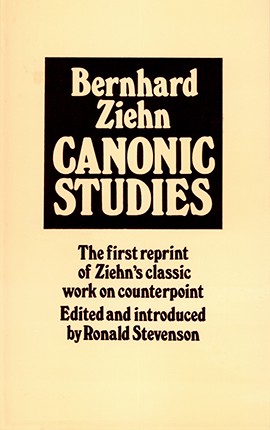
Canonic Studies
0
0
As an Amazon Associate and affiliate partner, Menrva Books earns from qualifying purchases. Learn more
Author Description
Ziehn (1845-1912) develops his theory of counterpoint. Key notions are: (i) inversion, in a 'real' rather than tonal, procedure, which often requires all twelve semitones and is not fixed to any particular key and (ii) canon - Ziehn saw imitation as a primary source of musical ideas. Ziehn was greatly influenced by Ferrucio Busoni, another sadly underappreciated composer and contrapuntalist, and it remains to be seen how much he may have influenced Schoenberg.
Menrva's Summary
THE THESIS
Bernhard Ziehn's "Canonic Studies" presents a rigorous exploration of counterpoint, focusing on the theoretical underpinnings of musical composition. Ziehn, influenced by Ferrucio Busoni, posits that inversion in music should be understood as a 'real' procedure, often utilizing all twelve semitones and transcending fixed tonal centers. He further emphasizes canon and imitation as fundamental sources for generating musical ideas, suggesting a potential, though yet unquantified, influence on later composers like Schoenberg.
THE SCOPE MAP
- Ziehn's theory of inversion, emphasizing its 'real' procedural aspects beyond tonal limitations.
- An examination of canon and imitation as primary sources for musical invention.
- Discussion of the twelve semitones and their role in compositional procedures.
- Analysis of Ziehn's theoretical framework and its potential connections to later composers.
THE AUTHORITY PERSPECTIVE
This work is regarded as a significant contribution to the study of musical counterpoint and composition theory. The text delves into Ziehn's unique perspective on inversion and canon, highlighting his theoretical innovations and his connection to influential figures like Busoni. Its detailed analysis makes it a valuable resource for scholars and composers interested in the historical development of compositional techniques.
Page Count:
0
Publication Date:
2006-01-01
ISBN-10:
0900707380
ISBN-13:
9780900707384
Non-Fiction
Music
Musicology
Composition
Music theory