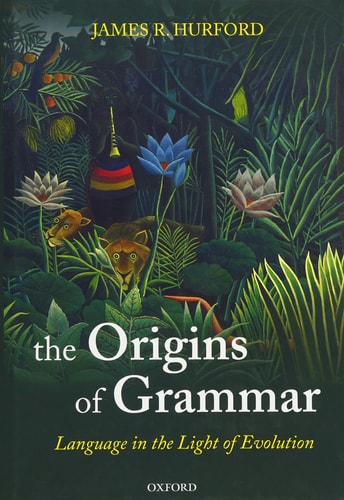
Language in the Light of Evolution, Vol. 2: The Origins of Grammar
0
0
As an Amazon Associate and affiliate partner, Menrva Books earns from qualifying purchases. Learn more
Author Description
This is the second of the two closely linked but self-contained volumes that comprise James Hurford's acclaimed exploration of the biological evolution of language. In the first book he looked at the evolutionary origins of meaning, ending as our distant ancestors were about to step over the brink to modern language. He now considers how that step might have been taken and the consequences it undoubtedly had.The capacity for language lets human beings formulate and express an unlimited range of propositions about real or fictitious worlds. It allows them to communicate these propositions, often overlaid with layers of nuance and irony, to other humans who can then interpret and respond to them. These processes take place at breakneck speed. Using a language means learning a vast number of arbitrary connections between forms and meanings and rules on how to manipulate them, both of which a normal human child can do in its first few years of life. James Hurford looks at how this miracle came about.The book is divided into three parts. In the first the author surveys the syntactic structures evident in the communicative behaviour of animals, such as birds and whales, and discusses how vocabularies of learned symbols could have evolved and the effects this had on human thought. In the second he considers how far the evolution of grammar depended on biological or cultural factors. In the third and final part he describes the probable route by which the human language faculty and languages evolved from simple beginnings to their present complex state.
Menrva's Summary
THE THESIS
This volume investigates the evolutionary mechanisms and biological precursors that enabled the emergence of complex grammatical structures in human language. James R. Hurford, a prominent scholar in the evolution of language, synthesizes evidence from animal communication, cognitive development, and evolutionary theory to propose a framework for how human syntax transitioned from simple symbolic systems to the sophisticated faculty observed today. He argues that the capacity for grammar is a result of both biological adaptation and cultural evolution, tracing the trajectory from pre-linguistic ancestors to modern communication.
THE SCOPE MAP
What You Will Find
- Comparative analysis of syntactic structures in non-human animal communication, including avian and cetacean vocalizations.
- Examination of the interplay between biological constraints and cultural transmission in the development of grammar.
- Theoretical modeling of the transition from learned symbol vocabularies to rule-based syntactic systems.
- A multi-part framework detailing the evolutionary timeline of the human language faculty from simple beginnings to modern complexity.
THE AUTHORITY PERSPECTIVE
Experts recognize this work as a significant contribution to the field of evolutionary linguistics, noting its rigorous approach to bridging biological and cultural explanations. Readers frequently highlight the academic density of the prose, which serves as a foundational text for those studying the intersection of biology and language development.
Page Count:
768
Publication Date:
2011-10-15
Publisher:
Oxford University Press
ISBN-10:
0199207879
ISBN-13:
9780199207879
Science
Anthropology
Linguistics
Historical linguistics
Evolutionary Biology
Community Tags
Similar Books