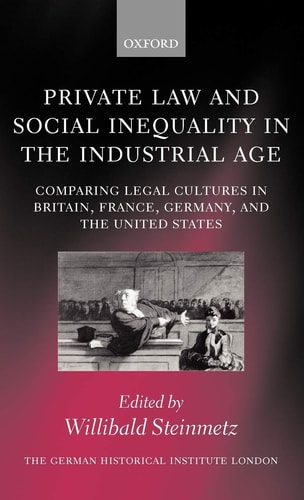
Private Law and Social Inequality in the Industrial Age: Comparing Legal Cultures in Britain, France, Germany, and the United States
0
0
As an Amazon Associate and affiliate partner, Menrva Books earns from qualifying purchases. Learn more
Author Description
The essays assembled here explore how private law historically helped to maintain, change, or upset inequalities common to all industrialized countries. The book deals with relations between lords and peasants, husbands and wives, masters and servants, landlords and tenants, and producers and consumers.
Menrva's Summary
THE THESIS
This work investigates the historical role of private law in reinforcing, modifying, or dismantling social inequalities across four major industrialized nations during the Industrial Age. Willibald Steinmetz, a scholar associated with the German Historical Institute, compiles a series of essays that analyze the legal frameworks governing domestic and economic hierarchies. By examining the shifting power dynamics between lords and peasants, husbands and wives, and masters and servants, the author argues that legal structures were not merely passive reflections of society but active instruments in shaping class and gender relations. The text utilizes a comparative methodology to highlight how different national legal cultures responded to the pressures of rapid industrialization.
THE SCOPE MAP
What You Will Find
- Comparative analysis of legal systems in Britain, France, Germany, and the United States.
- Examination of power dynamics in domestic, labor, and property relationships.
- Historical investigation into the evolution of private law from the 19th to the early 20th century.
- Case studies focusing on the legal status of peasants, tenants, and consumers.
THE AUTHORITY PERSPECTIVE
Legal historians and sociologists frequently cite this collection as a vital resource for understanding the intersection of civil law and social stratification. Scholars note the academic density of the prose, which provides a rigorous framework for comparative legal studies.
Page Count:
584
Publication Date:
2000-07-27
Publisher:
OUP/German Historical Institute London
ISBN-10:
0199202362
ISBN-13:
9780199202362
History
Law
Comparative History
Industrial history
Social justice
Civil Law
Sociology
Community Tags
Similar Books