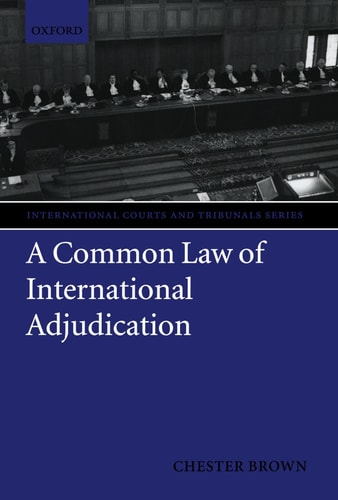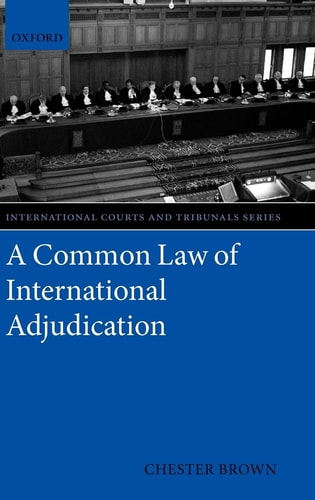
A Common Law of International Adjudication
0
0
As an Amazon Associate and affiliate partner, Menrva Books earns from qualifying purchases. Learn more
Author Description
The proliferation of international courts and tribunals has given rise to several new issues affecting the administration of international justice. This book makes a significant contribution to understanding the impact of this proliferation by addressing one important question: namely, whether international courts and tribunals are increasingly adopting common approaches to issues of procedure and remedies. This book's central argument is that there is an increasing commonality in the practice of international courts to the application of rules concerning these issues, and that this represents the emergence of a common law of international adjudication.The book examines this question by considering several key issues relating to procedure and remedies, and analyzes relevant international jurisprudence to demonstrate that there is substantial commonality. It goes on to look at why international courts are increasingly adopting common approaches to such questions, and why a greater degree of commonality may be found with respect to some issues rather than others. In doing so, light is shed on the methods adopted by international courts to engage in the cross-fertilization of legal principles.The emergence of a common law of international adjudication has important practical and theoretical implications, as it suggests that international courts can also devise common approaches to the challenges that they face in the age of proliferation. It also suggests that international courts do not generally operate as self-contained regimes, but rather that they regard themselves as forming part of a community of international courts, therefore having positive implications for the development of the international legal system.
Menrva's Summary
THE THESIS
This book investigates whether international courts and tribunals are increasingly adopting common approaches to procedural rules and remedies, thereby forming a nascent common law of international adjudication. Chester Dr. Brown, a scholar of international law, utilizes an extensive analysis of international jurisprudence to argue that these institutions are moving away from operating as isolated regimes. By examining the cross-fertilization of legal principles, the author posits that these courts view themselves as a cohesive community, which significantly impacts the development and administration of the international legal system.
THE SCOPE MAP
What You Will Find
- Comparative analysis of procedural rules across various international courts and tribunals.
- Examination of remedies and their application in diverse international legal contexts.
- Evaluation of the factors driving the convergence of legal practices in the age of institutional proliferation.
- Theoretical framework regarding the interaction between independent international judicial bodies.
THE AUTHORITY PERSPECTIVE
Legal scholars and practitioners frequently cite this work as a foundational text for understanding the procedural evolution of international tribunals. Readers often note the academic density of the prose, which provides a rigorous examination of how international courts navigate the challenges of a fragmented legal landscape.
Page Count:
280
Publication Date:
2007-10-25
Publisher:
Oxford University Press
ISBN-10:
0199206503
ISBN-13:
9780199206506
Administrative Courts
Law
Jurisprudence
International Law