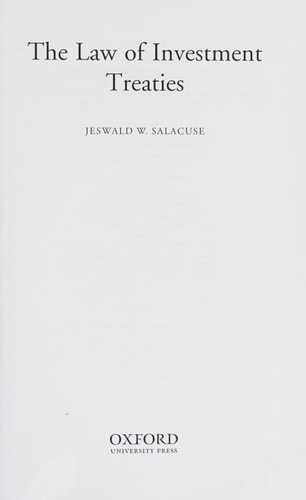
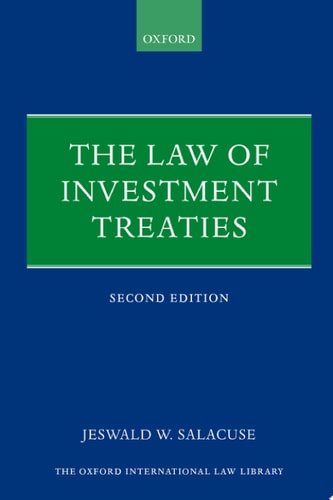
The Law of Investment Treaties
0
0
As an Amazon Associate and affiliate partner, Menrva Books earns from qualifying purchases. Learn more
Author Description
Investment treaties, which grant special international protection to foreign investors and give them a means to enforce those rights against States in which they have invested, have become increasingly important in planning, executing and managing international investments. The Law of Investment Treaties explains the nature, history, and significance of investment treaties and their impact on international investors and investments, as well as on governments that are parties to them.The international law governing trans-national investments has undergone a remarkable transformation in a relatively short time. The fundamental tool for effecting that transformation has been the investment treaty, in which contracting countries set down rules to govern investments by their respective nationals in each other's territories. They include the North American Free Trade Agreement, the Energy Charter Treaty, and some 2500 bilateral investment treaties. This trend is bound to grow in the future. While differing in particular provisions, investment treaties all do two things: 1) they grant special protective rights to foreign investors, and 2) they provide for mechanisms that allow investors to enforce those rights, usually by international arbitration.The Law of Investment Treaties examines the nature, history, and significance of investment treaties and their impact particularly on protected investors and investments, as well as on governments. Although the precise provisions of investment treaties are not uniform and some treaties restrict host country governmental action more than others, virtually all investment treaties address the same issues. Drawing on the growing body of arbitration decisions applying and interpreting investment treaties, this book examines in detail these common issues, including the scope of application, conditions for the entry of foreign investment and general standards of treatment of foreign investments (including increasingly common concepts such as "fair and equitable treatment" "national treatment", "most-favored-nation treatment" etc.). Monetary transfers, operational conditions, protection against expropriation and dispossession and compensation for losses are also explored. Salacuse also discusses dispute settlement, including negotiation, arbitration, conciliation, and judicial proceedings.
Menrva's Summary
THE THESIS
This book investigates the legal framework, historical evolution, and practical enforcement mechanisms of international investment treaties that govern the relationship between foreign investors and host states. Jeswald W. Salacuse, a scholar in international investment law, utilizes a comprehensive analysis of bilateral investment treaties and multilateral agreements to explain how these instruments protect foreign capital. The text argues that investment treaties have become the primary mechanism for regulating trans-national economic activity by establishing standardized rules for investor protection and dispute resolution.
THE SCOPE MAP
What You Will Find
- Analysis of the historical development and legal nature of investment treaties.
- Examination of common treaty provisions including scope of application and conditions for entry.
- Review of international arbitration decisions used to interpret treaty standards.
- Discussion of the impact of treaty obligations on host country governmental actions.
THE AUTHORITY PERSPECTIVE
Legal professionals and academics frequently cite this work as a foundational text for understanding the mechanics of international investment arbitration. Readers often note the high level of technical detail, making it a standard reference for practitioners navigating the complexities of trans-national investment law.
Page Count:
517
Publication Date:
2010-03-19
Publisher:
Oxford University Press
ISBN-10:
0199206058
ISBN-13:
9780199206056
Economics
Business
Finance
Law
International Law
Arbitration and award
Professional Career & Trade
Community Tags
Other Editions(8)



Similar Books






Reader Comments
Share Your Thoughts
No comments yet. Be the first to share your thoughts!