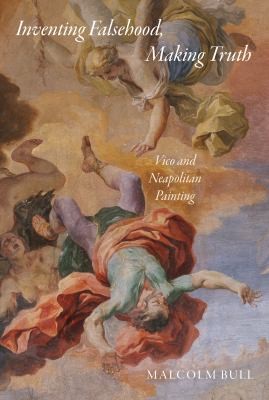
Inventing Falsehood, Making Truth: Vico and Neapolitan Painting
0
0
As an Amazon Associate and affiliate partner, Menrva Books earns from qualifying purchases. Learn more
Author Description
Can painting transform philosophy? In Inventing Falsehood, Making Truth, Malcolm Bull looks at Neapolitan art around 1700 through the eyes of the philosopher Giambattista Vico. Surrounded by extravagant examples of late Baroque painting by artists like Luca Giordano and Francesco Solimena, Vico concluded that human truth was a product of the imagination. Truth was not something that could be observed: instead, it was something made in the way that paintings were made--through the exercise of fantasy. Juxtaposing paintings and texts, Bull presents the masterpieces of late Baroque painting in early eighteenth-century Naples from an entirely new perspective. Revealing the close connections between the arguments of the philosophers and the arguments of the painters, he shows how Vico drew on both in his influential philosophy of history, The New Science. Bull suggests that painting can serve not just as an illustration for philosophical arguments, but also as the model for them--that painting itself has sometimes been a form of epistemological experiment, and that, perhaps surprisingly, the Neapolitan Baroque may have been one of the routes through which modern consciousness was formed
Menrva's Summary
THE THESIS
This book investigates the relationship between Neapolitan Baroque painting and the philosophical ideas of Giambattista Vico around 1700. Malcolm Bull examines how Vico, surrounded by the vibrant and imaginative works of artists like Luca Giordano and Francesco Solimena, developed his concept of truth as a product of human imagination rather than observation. The book juxtaposes paintings and texts to argue that painting served not merely as illustration but as a model for philosophical inquiry, functioning as an epistemological experiment. Bull posits that Neapolitan Baroque art may have played a role in the formation of modern consciousness.
THE SCOPE MAP
- Analysis of Neapolitan Baroque painting around 1700, focusing on artists such as Luca Giordano and Francesco Solimena.
- Exploration of Giambattista Vico's philosophy, particularly his concept of truth as a product of imagination.
- Juxtaposition of visual art and philosophical texts to reveal connections between painters and philosophers.
- Argument that painting can serve as a model for philosophical arguments and as an epistemological experiment.
- Discussion of the influence of Neapolitan Baroque art on Vico's philosophy of history, 'The New Science'.
- Examination of how Neapolitan Baroque art may have contributed to the development of modern consciousness.
THE AUTHORITY PERSPECTIVE
Malcolm Bull's 'Inventing Falsehood, Making Truth' offers a novel perspective on Neapolitan Baroque painting by connecting it to the philosophical theories of Giambattista Vico. The book is praised for its insightful juxtaposition of art and text, revealing how painters and philosophers of the era influenced each other. It argues compellingly that visual art can function as a model for philosophical thought and even as an epistemological experiment. The work is seen as a significant contribution to understanding the formation of modern consciousness through the lens of 18th-century Neapolitan art and Vico's seminal ideas.
Page Count:
144
Publication Date:
2013-01-01
ISBN-10:
0691138842
ISBN-13:
9780691138848
Art
Non-Fiction
History
Philosophy
History of Ideas
Art History
Baroque Art
Community Tags
Similar Books














