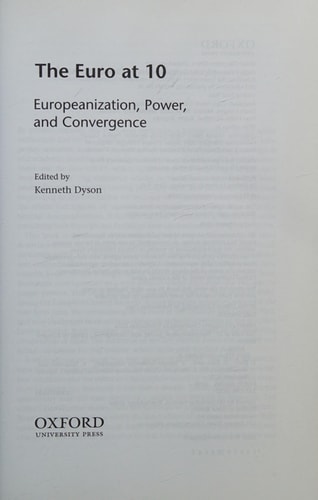
The Euro at Ten: Europeanization, Power, and Convergence
0
0
As an Amazon Associate and affiliate partner, Menrva Books earns from qualifying purchases. Learn more
Author Description
With Economic and Monetary Union (EMU) the European Union is embarked on a major historic political project of formidable technical complexity. In January 2009 the Euro Area will be ten years old. What does the evidence from the first decade tell us about the significance of the euro for the EU and its member states? This book brings together a range of recognized academic specialists to examine the main political aspects of this question. How, and in what ways, has the euro Europeanized states (members and non-members), their institutions, policies and politics? What have been its effects on the location and use of power? Has the euro generated convergence or divergence? What political patterns can be identified? The book offers the first, in-depth and systematic political analysis of the first decade of the euro. It places the euro in its global and European contexts; offers a set of case studies of its effects on a representative sample of EU member states ('Anglo-Saxon', old 'D-Mark Zone', east central European and Baltic, Mediterranean, and Nordic); and looks at three key sectors (financial markets, wages and collective bargaining, and welfare reform). The book contributes to Europeanization studies, comparative political economy, and studies of Economic and Monetary Union (EMU). It will be of major interest to students of the European Union and European integration, comparative European politics, and area and 'country' studies.
Menrva's Summary
THE THESIS
This book investigates the political consequences and structural impacts of the euro during its first decade of existence. Kenneth Dyson, a prominent scholar in European politics, assembles a team of academic specialists to evaluate how the Economic and Monetary Union (EMU) has influenced state institutions, policy-making, and power dynamics across Europe. The text utilizes a comparative political economy framework to assess whether the currency has fostered convergence or divergence among member states.
THE SCOPE MAP
What You Will Find
- Comparative analysis of the euro's impact on diverse member state groupings including the D-Mark Zone, Mediterranean, and Nordic regions.
- Systematic examination of key sectors such as financial markets, wage bargaining, and welfare reform.
- Case studies evaluating the Europeanization of national institutions and political processes.
- Theoretical contributions to the study of European integration and comparative political economy.
THE AUTHORITY PERSPECTIVE
Experts recognize this work as a foundational political analysis of the euro's first decade, frequently citing its comprehensive approach to institutional change. Scholars and students of European integration often note the academic density of the prose, which provides a rigorous examination of complex monetary and political interactions.
Page Count:
470
Publication Date:
2008-10-15
Publisher:
Oxford University Press
ISBN-10:
0199208867
ISBN-13:
9780199208869
History
Economics
European Union
International relations
Euro
Europe
Community Tags
Similar Books