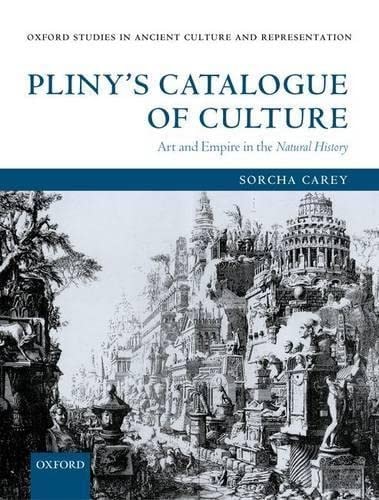
Pliny's Catalogue of Culture: Art and Empire in the Natural History
0
0
As an Amazon Associate and affiliate partner, Menrva Books earns from qualifying purchases. Learn more
Author Description
One of the earliest surviving examples of 'art history', Pliny the Elder's 'chapters on art' form part of his encyclopaedic Natural History, completed shortly before its author died during the eruption of Vesuvius in AD 79. This important new work argues that the Natural History offers a sophisticated account of the world as empire, in which art as much as geography can be used to expound a Roman imperial agenda. Reuniting the 'chapters on art' with the rest of the Natural History, Sorcha Carey considers how the medium of the 'encyclopaedia' affects Pliny's presentation of art, and reveals how art is used to explore themes important to the work as a whole. Throughout, the author demonstrates that Pliny's 'chapters on art' are a profoundly Roman creation, offering an important insight into responses to art and culture under the early Roman empire.
Menrva's Summary
THE THESIS
This work investigates how Pliny the Elder’s 'chapters on art' function as a deliberate instrument of Roman imperial ideology within his broader encyclopaedic project. Sorcha Carey, a scholar of classical literature and culture, analyzes the Natural History not merely as a collection of facts, but as a structured representation of the world under Roman hegemony. By reintegrating the art-historical segments with the surrounding text, Carey argues that Pliny utilizes geography, natural phenomena, and artistic production to construct a cohesive narrative of imperial power and cultural dominance. The book examines the interplay between the medium of the encyclopaedia and the specific political objectives of the early Roman Empire.
THE SCOPE MAP
What You Will Find
- Analysis of Pliny the Elder’s 'chapters on art' within the context of the Natural History.
- Examination of the relationship between Roman imperial expansion and the categorization of art.
- Exploration of how the encyclopaedic format shapes the reader's perception of cultural artifacts.
- Discussion of Roman responses to Greek art and the construction of a distinct imperial identity.
THE AUTHORITY PERSPECTIVE
Scholars recognize this text as a significant contribution to the study of Roman art history and the intellectual framework of the early empire. The book is frequently cited for its ability to bridge the gap between technical art history and broader cultural studies, making it a valuable resource for classicists and historians alike.
Page Count:
222
Publication Date:
2007-02-08
Publisher:
Oxford University Press
ISBN-10:
0199207658
ISBN-13:
9780199207657
History
Natural history
Art History
Ancient History
Roman Empire
Art
Community Tags
Other Editions(3)

Similar Books