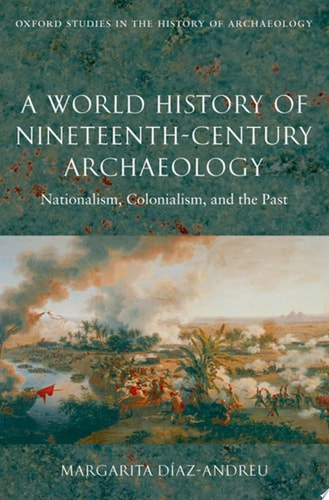
A World History of Nineteenth-Century Archaeology: Nationalism, Colonialism, and the Past
0
0
As an Amazon Associate and affiliate partner, Menrva Books earns from qualifying purchases. Learn more
Author Description
Margarita Diaz-Andreu offers an innovative history of archaeology during the nineteenth century, encompassing all its fields from the origins of humanity to the medieval period, and all areas of the world. The development of archaeology is placed within the framework of contemporary political events, with a particular focus upon the ideologies of nationalism and imperialism. Diaz-Andreu examines a wide range of issues, including the creation of institutions, the conversion of the study of antiquities into a profession, public memory, changes in archaeological thought and practice, and the effect on archaeology of racism, religion, the belief in progress, hegemony, and resistance.
Menrva's Summary
THE THESIS
This work investigates how the development of archaeology as a professional discipline in the nineteenth century was fundamentally shaped by the intersecting forces of nationalism and imperialism. Margarita Diaz-Andreu, a scholar specializing in the history of archaeology, utilizes a global comparative framework to analyze how political ideologies influenced the study of the past. By examining the institutionalization of the field, she argues that archaeological practice was never a neutral endeavor but rather a tool for constructing national identities and justifying colonial expansion. The text synthesizes archival research and historical analysis to demonstrate the profound impact of contemporary political climates on the interpretation of human history.
THE SCOPE MAP
What You Will Find
- A global survey of archaeological development across all continents during the nineteenth century.
- Analysis of the transition from amateur antiquarianism to a formalized, professional academic discipline.
- Examination of the role of racism, religious belief, and the concept of progress in shaping archaeological narratives.
- Case studies on the creation of museums, state-sponsored excavations, and the institutionalization of heritage management.
THE AUTHORITY PERSPECTIVE
Experts recognize this volume as a foundational text for understanding the political dimensions of nineteenth-century archaeological practice. Readers frequently note the academic density of the prose, which provides a comprehensive and rigorous historical account of the field's evolution.
Page Count:
504
Publication Date:
2008-01-10
Publisher:
Oxford University Press
ISBN-10:
0199217173
ISBN-13:
9780199217175
History
Academic
Colonialism
Archaeology
Nineteenth century
Nationalism
Community Tags
Similar Books