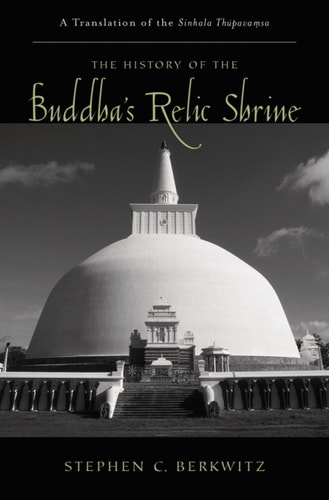
History of the Buddha's Relic Shrine: A Translation of the Sinhala Thūpavamsa
0
0
As an Amazon Associate and affiliate partner, Menrva Books earns from qualifying purchases. Learn more
Author Description
Buddhist chronicles have long been had a central place in the study of Buddhism. Scholars, however, have relied almost exclusively on Pali works that were composed by elites for learned audiences, to the neglect of a large number of Buddhist histories written in local languages for popular consumption. The Sinhala Thūpavamsa, composed by Parakama Pandita in thirteenth-century Sri Lanka, is an important example of a Buddhist chronicle written in the vernacular Sinhala language. Furthermore, it is among those works that inform public discussion and debate over the place of Buddhism in the Sri Lankan nation state and the role of Buddhist monks in contemporary politics. In this book Stephen Berkwitz offers the first complete English translation of the Sinhala Thūpavamsa. Composed in a literary dialect of Sinhala, it contains a richly descriptive account of how Buddhism spread outside of India, replete with poetic embellishments and interpolations not found in other accounts of those events. Aside from being an important literary work, the Sinhala Thūpavamsa. is a text of considerable historical and religious significance. It comprises several narrative strands that relate the life story of the Buddha and the manner in which Buddhist teachings and institutions were established on the island of Sri Lanka in ancient times. The central focus of this work concerns the variety of relics associated with the historical Buddha, particularly how the relics were acquired and the presumed benefits of venerating them. The text also relates the mythological history of the Buddha's previous lives as a bodhisattva and concludes with a prediction about the future Buddha Maitreya. Reflection on Buddhist ethics and instruction on the Dharma, or the Buddha's teaching, are found throughout the work, indicating that this historical narrative was meant both to recall the past and give rise to religious practice among contemporary readers and listeners. This new translation makes a significant
Menrva's Summary
THE THESIS
This work investigates the historical and religious significance of the Sinhala Thūpavamsa, a thirteenth-century Buddhist chronicle, by providing the first complete English translation of the text. Stephen C. Berkwitz, a scholar of Buddhist studies, utilizes this vernacular text to challenge the academic reliance on Pali-language sources, arguing that local-language chronicles offer essential insights into popular Buddhist practice and national identity in Sri Lanka. The book presents a framework for understanding how narrative accounts of relics and the life of the Buddha were used to shape religious devotion and institutional authority.
THE SCOPE MAP
What You Will Find
- A complete English translation of the thirteenth-century Sinhala Thūpavamsa.
- Detailed accounts of the Buddha's life, previous incarnations, and the future Buddha Maitreya.
- Analysis of the cultural and political role of relic veneration in Sri Lankan history.
- Contextual commentary on the transition of Buddhist teachings from India to Sri Lanka.
Scope Limits
- The text focuses primarily on the Sinhala vernacular tradition rather than the broader Pali canon.
- It does not provide an exhaustive history of all Buddhist relics, focusing instead on those central to the Thūpavamsa narrative.
THE AUTHORITY PERSPECTIVE
Scholars recognize this translation as a critical contribution to the study of vernacular Buddhist literature and the history of Sri Lankan religious institutions. Readers frequently note the academic rigor of the translation and its utility in understanding the intersection of Buddhist narrative and contemporary political discourse.
Page Count:
320
Publication Date:
2006-01-01
Publisher:
Oxford University Press
ISBN-10:
0190293829
ISBN-13:
9780190293826
History
Religion
Buddhism
Academic
Translation
Community Tags
Similar Books