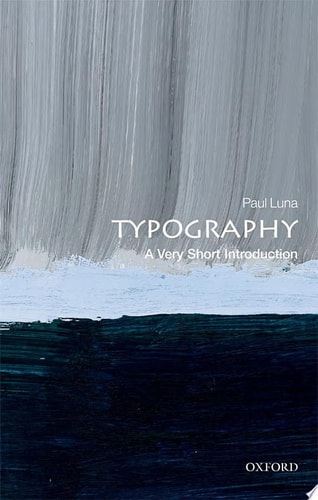
Typography: A Very Short Introduction
0
0
As an Amazon Associate and affiliate partner, Menrva Books earns from qualifying purchases. Learn more
Author Description
Typography, the art of designing printed words, was once the domain of an elite few artists but has become an area with which millions of people engage daily. The widespread usage of digital devices from laptops to tablets and smart phones which are used for written communications means that we are regularly asked to make decisions about the fonts, sizes, and layouts we use in our writing. This broadening engagement with the field of typography has led to a perceptible shift from debates about legibility and technicalities to conversations about which fonts best reflect the writer's personality or style.In this Very Short Introduction, Paul Luna offers a broad definition of typography as design for reading, whether in print or on screens, where a set of visual choices are taken to make a written message more accessible, more easily transmitted, more significant, or more attractive. Considering the development of letterforms and the shapes of letter we use, Luna discusses the history behind our modern day letters and fonts, before considering the issues behind key typographic decisions, and the differences between printed and on-screen typography. Presenting any piece of typography as a fundamental design choice, Luna introduces the options available today, and explores the reasons why key typographic decisions are made.ABOUT THE SERIES: The Very Short Introductions series from Oxford University Press contains hundreds of titles in almost every subject area. These pocket-sized books are the perfect way to get ahead in a new subject quickly. Our expert authors combine facts, analysis, perspective, new ideas, and enthusiasm to make interesting and challenging topics highly readable.
Menrva's Summary
THE THESIS
This book investigates the evolution of typography from an elite technical craft to a ubiquitous daily practice in the digital age. Paul Luna, a distinguished expert in the field, utilizes historical context and contemporary design theory to argue that typography is fundamentally a design choice intended to enhance the accessibility and impact of written communication. He provides a framework for understanding how visual decisions regarding fonts and layouts influence the transmission of meaning across both print and digital media.
THE SCOPE MAP
What You Will Find
- Historical development of letterforms and modern font evolution
- Comparative analysis of print versus on-screen typographic requirements
- Examination of the relationship between font choice and personal style
- Methodologies for making informed decisions regarding legibility and visual hierarchy
THE AUTHORITY PERSPECTIVE
Experts recognize this work as a concise and accessible entry point for those seeking to understand the mechanics of design for reading. Readers frequently note that the text successfully bridges the gap between historical technicality and the practical demands of modern digital communication.
Page Count:
176
Publication Date:
2019-02-01
Publisher:
Oxford University Press
ISBN-10:
0199211299
ISBN-13:
9780199211296
Non-Fiction
Reference
Type And Type-founding
Typesetting
Design
Typography
Graphic Design
Humanities