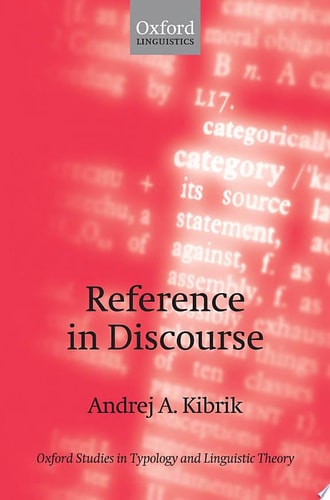
Reference in Discourse: Oxford Studies in Typology and Linguistic Theory
0
0
As an Amazon Associate and affiliate partner, Menrva Books earns from qualifying purchases. Learn more
Author Description
This is the first full study of how people refer to entities in natural discourse. It contributes to the understanding of both linguistic diversity and the cognitive underpinnings of language and it provides a framework for further research in both fields. Andrej Kibrik focuses on the way specific entities are mentioned in natural discourse, during which about every third word usually depends on referential choice. He considers reference as an overt representation of underlying cognitive processes and combines a theoretically-oriented cognitive approach with empirically-based cross-linguistic analysis. He begins by introducing the cognitive approach to discourse analysis and by examining the relationship between discourse studies and linguistic typology. He discusses reference as a linguistic phenomenon, in connection with the traditional notions of deixis, anaphora, givenness, and topicality, and describes the way his theoretical approach is centered on notions of referent activation in working memory. He argues that the speaker is responsible for the shape of discourse and that referential expressions should be understood as choices made by speakers rather than as puzzles to be solved by addressees.Kibrik examines the cross-linguistic aspects of reference and the typology of referential devices, including referring expressions per se, such as free and bound pronouns, and referential aids that help to tell apart the concurrently activated entities. This discussion is based on the data from about 200 languages from around the world. He then proposes a comprehensive model of referential choice, in which he draws on concepts from cognitive linguistics, psycholinguistics, cognitive psychology, and cognitive neuroscience, and applies this to Russian and English. He also draws together his empirical analyses in order to examine what light his analysis of discourse can shed on the way information is processed in working memory. In the final part of the book Andrej Kibrik offers a wider perspective, including deixis, referential aspects of gesticulation and signed languages.This pioneering work will interest linguists and cognitive scientists interested in discourse, reference, typology, and the operations of working memory in linguistic communication.
Menrva's Summary
THE THESIS
This book investigates the cognitive and linguistic mechanisms governing how speakers select referential expressions within natural discourse. Andrej A. Kibrik, a specialist in linguistic typology and cognitive linguistics, synthesizes empirical data from approximately 200 languages to construct a comprehensive model of referential choice. He argues that referential expressions are active choices made by speakers to manage the listener's working memory, rather than static linguistic puzzles. By integrating cognitive psychology, neuroscience, and cross-linguistic analysis, the author provides a framework for understanding how language structure reflects underlying cognitive processes.
THE SCOPE MAP
What You Will Find
- A cross-linguistic analysis of referential devices including free and bound pronouns across 200 languages.
- A theoretical framework linking discourse analysis to cognitive processes such as referent activation in working memory.
- Methodologies for examining deixis, anaphora, givenness, and topicality within natural speech.
- A comparative application of the proposed model to Russian and English linguistic data.
THE AUTHORITY PERSPECTIVE
Experts recognize this work as a foundational text for scholars interested in the intersection of cognitive linguistics and discourse typology. Readers frequently note the academic density of the prose, which serves as a rigorous resource for advanced students and researchers in the field of language science.
Page Count:
688
Publication Date:
2011-11-07
Publisher:
Oxford University Press
ISBN-10:
0199215804
ISBN-13:
9780199215805
Discourse Analysis
Typology
Reference
Linguistics
Community Tags
Similar Books
Reader Comments
Share Your Thoughts
No comments yet. Be the first to share your thoughts!