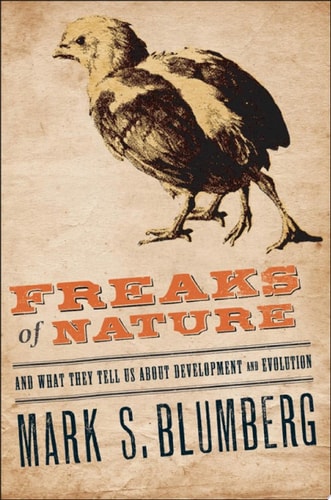
Freaks of Nature: And What They Tell Us About Evolution and Development
0
0
As an Amazon Associate and affiliate partner, Menrva Books earns from qualifying purchases. Learn more
Author Description
Two-legged goats, conjoined twins, 'Cyclops' infants with a single eye in the middle of their forehead, double-headed snakes, and Laloo, a man with a partially formed twin attached to his chest... In iFreaks of Nature/i, Mark S. Blumberg turns a scientist's eye on these unusual examples ofhumans and other animals, showing how a subject once relegated to the sideshow can help explain some of the deepest complexities of biology.These examples of extreme bodily anomalies are in fact the natural products of development, and it is through such developmental mechanisms that evolution works. And Blumberg shows how 'freak' deformities can provide valuable windows on the intimate connections between genetics, development, theenvironment, and evolution. In taking seriously a subject that has often been shunned as discomfiting and embarrassing, Freaks of Nature takes the perspective of evolutionary developmental biology to shed new light on how individuals--and entire species--develop, survive, and evolve.
Menrva's Summary
THE THESIS
This book investigates how extreme developmental anomalies in humans and animals serve as critical evidence for understanding the mechanisms of evolution and biological development. Mark S. Blumberg, a professor of psychology and behavioral neuroscience, utilizes a framework rooted in evolutionary developmental biology (evo-devo) to argue that these rare physical variations are not mere curiosities but are essential products of the same developmental processes that shape all life. By examining the interplay between genetics, environmental factors, and developmental pathways, the author demonstrates that these anomalies provide a unique lens through which to view the broader principles of biological change and adaptation.
THE SCOPE MAP
What You Will Find
- Analysis of extreme bodily anomalies including conjoined twins, cyclopia, and polycephaly.
- An exploration of the developmental mechanisms that govern how organisms grow and change.
- Integration of genetics, environmental influences, and evolutionary theory to explain biological variation.
- A historical and scientific re-evaluation of how developmental biology informs our understanding of species evolution.
THE AUTHORITY PERSPECTIVE
Experts and readers alike recognize this work as a significant contribution to the field of evolutionary developmental biology, noting its ability to make complex biological concepts accessible to a general audience. The text is frequently cited for its balanced approach, successfully bridging the gap between historical fascination with biological anomalies and modern scientific rigor.
Page Count:
352
Publication Date:
2009-01-01
Publisher:
Oxford University Press
ISBN-10:
0199213054
ISBN-13:
9780199213054
Science
Natural History
Developmental Biology
Evolutionary Biology
Genetics
Animals
Evolution Biology
Natural selection
Biology