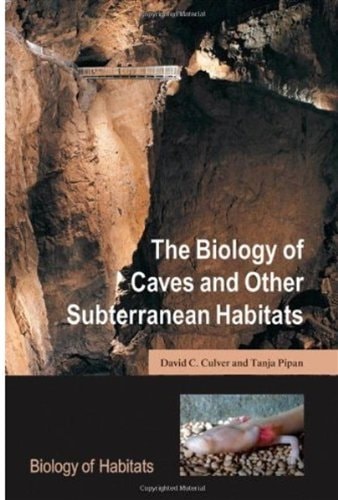
The Biology of Caves and Other Subterranean Habitats (Biology of Habitats Series)
0
0
As an Amazon Associate and affiliate partner, Menrva Books earns from qualifying purchases. Learn more
Author Description
Caves and other subterranean habitats with their often strange (even bizarre) inhabitants have long been objects of fascination, curiosity, and debate. The question of how such organisms have evolved, and the relative roles of natural selection and genetic drift, has engaged subterranean biologists for decades. Indeed, these studies continue to inform the more general question of adaptation and evolution. However, interest in subterranean biology is not limited to questions of evolutionary biology. Both the distribution and the apparent ancient age of many subterranean species continue to be of significant interest to biogeographers. Subterranean ecosystems generally exhibit little or no primary productivity and, as "extreme" ecosystems, provide general insights into ecosystem function. Furthermore, the simplicity of subterranean communities relative to most surface-dwelling communities makes them useful model systems for the study of species interactions such as competition and predation, as well as more general principles of ecosystem function. The rarity of many cave species makes them of special interest in conservation biology.The Biology of Caves and other Subterranean Habitats offers a concise but comprehensive introduction to cave ecology. While there is an emphasis on the organisms that dominate this unique environment, conservation and management aspects are also considered. The book includes a global range of examples and case studies from both caves and non-cave subterranean habitats; it also provides a clear explanation of specialized terms used by speleologists. This accessible text will appeal to researchers new to the field and to the many professional ecologists and conservation practitioners requiring a concise but authoritative overview. Its engaging style will also make it suitable for senior undergraduate and graduate students taking courses in cave and subterranean biology.Each of the books in the Oxford Biology of Habitats Series introduces a different habitat, and gives an integrated overview of the design, physiology, ecology, and behaviour of the organisms found there. The practical aspects of working within each habitat, the sorts of studies that are possible, and habitat biodiversity and conservation status are all explored.
Menrva's Summary
THE THESIS
This text investigates the evolutionary mechanisms, ecological functions, and conservation requirements of organisms inhabiting subterranean environments. Authors David C. Culver and Tanja Pipan utilize their extensive expertise in speleobiology to synthesize current research on how extreme, low-productivity habitats shape species adaptation. The book provides a rigorous framework for understanding the interplay between natural selection, genetic drift, and biogeography within these isolated ecosystems.
THE SCOPE MAP
What You Will Find
- Analysis of evolutionary processes including natural selection and genetic drift in cave-dwelling species.
- Examination of ecosystem function in environments with little to no primary productivity.
- Global case studies covering diverse subterranean habitats beyond traditional caves.
- Methodologies for the conservation and management of rare subterranean biodiversity.
THE AUTHORITY PERSPECTIVE
Experts recognize this work as a foundational text for students and professionals seeking a concise overview of subterranean ecology. Readers frequently note the clarity with which the authors explain specialized speleological terminology while maintaining academic rigor.
Page Count:
254
Publication Date:
2009-03-30
Publisher:
Oxford University Press
ISBN-10:
0199219923
ISBN-13:
9780199219926
Science
Nature
Conservation
Cave Animals
Biology
Ecology
Zoology
Life sciences
Community Tags
Similar Books








Reader Comments
Share Your Thoughts
No comments yet. Be the first to share your thoughts!