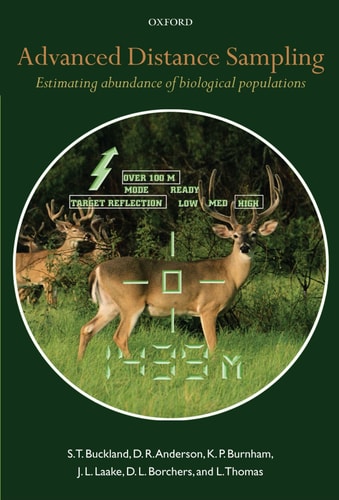
Advanced Distance Sampling: Estimating Abundance of Biological Populations
0
0
As an Amazon Associate and affiliate partner, Menrva Books earns from qualifying purchases. Learn more
Author Description
This advanced text focuses on the uses of distance sampling to estimate the density and abundance of biological populations. It addresses new methodologies, new technologies and recent developments in statistical theory and is the follow up companion to Introduction to Distance Sampling (OUP, 2001).In this text, a general theoretical basis is established for methods of estimating animal abundance from sightings surveys, and a wide range of approaches to analysis of sightings data is explored. These approaches include: modelling animal detectability as a function of covariates, where the effects of habitat, observer, weather, etc. on detectability can be assessed; estimating animal density as a function of location, allowing for example animal density to be related to habitat and other locational covariates; estimating change over time in populations, a necessary aspect of any monitoring program; estimation when detection of animals on the line or at the point is uncertain, as often occurs for marine populations, or when the survey region has dense cover; survey design and automated design algorithms, allowing rapid generation of sound survey designs using geographic information systems; adaptive distance sampling methods, which concentrate survey effort in areas of high animal density; passive distance sampling methods, which extend the application of distance sampling to species that cannot be readily detected in sightings surveys, but can be trapped; and testing of methods by simulation, so that performance of the approach in varying circumstances can be assessed.
Menrva's Summary
THE THESIS
This text investigates the advanced statistical methodologies required to accurately estimate the density and abundance of biological populations using distance sampling techniques. The authors, a team of prominent researchers in ecological statistics, build upon foundational principles to address complex variables in wildlife monitoring. By integrating recent developments in statistical theory and technological advancements, the book provides a rigorous framework for analyzing sightings data in diverse environments. The work serves as a technical extension to established literature, offering sophisticated solutions for researchers managing large-scale population surveys.
THE SCOPE MAP
What You Will Find
- Advanced modeling of animal detectability incorporating environmental and observer covariates.
- Methodologies for estimating density as a function of spatial location and habitat features.
- Techniques for monitoring population changes over time and addressing detection uncertainty.
- Algorithms for automated survey design using geographic information systems.
- Adaptive and passive distance sampling strategies for specialized species detection.
- Simulation-based testing protocols to evaluate method performance under varying conditions.
THE AUTHORITY PERSPECTIVE
Experts recognize this volume as a critical technical resource for professional ecologists and statisticians involved in wildlife management. Readers frequently note the high level of mathematical density and the specialized nature of the statistical models presented throughout the text.
Page Count:
434
Publication Date:
2008-02-09
Publisher:
Oxford University Press
ISBN-10:
0199225877
ISBN-13:
9780199225873
Science
Statistics
Biology
Ecology
Sampling statistics
Reference
Mathematics
Community Tags
Similar Books