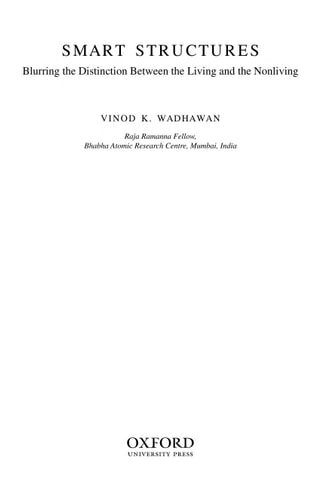
Smart Structures: Blurring the Distinction Between the Living and the Nonliving
0
0
As an Amazon Associate and affiliate partner, Menrva Books earns from qualifying purchases. Learn more
Author Description
A structure is an assembly that serves an engineering function. A smart structure is one that serves this function smartly i.e. by responding adaptively in a pre-designed useful and efficient manner to changing environmental conditions. Adaptive behavior of one of more materials constituting a smart structure requires nonlinear response. This book describes the three main types of nonlinear-response materials: ferroic materials, sort materials, and nanostructured materials. Information processing by biological and artificial smart structures is also discussed. A smart structure typical has sensors, actuators and a control system. Progress in all these aspects of smart structures has leant heavily on mimicking Nature and the all-important notion in this context has been that of evolution. Artificial Darwinian and Lamarckian evolution holds the key to the development of truly smart structures. Modestly intelligent robots are already on the horizon. Projections about the low cost availability of adequate computing power and memory size indicate that the future really belongs to smart structures. This book covers in a compact format the entire gamut of concepts relevant to smart structures. It will be of interest to a wide range of students and professionals in science and engineering.
Menrva's Summary
THE THESIS
This book investigates the fundamental principles and engineering requirements necessary to create smart structures that exhibit adaptive, nonlinear responses to environmental stimuli. Vinod K. Wadhawan, an expert in materials science, synthesizes concepts from physics and chemistry to define the intersection of biological and artificial systems. The text argues that the future of engineering lies in mimicking natural evolutionary processes to develop materials capable of autonomous information processing and adaptive behavior.
THE SCOPE MAP
What You Will Find
- Analysis of nonlinear-response materials including ferroic, soft, and nanostructured materials.
- Examination of the core components of smart structures: sensors, actuators, and control systems.
- Exploration of artificial Darwinian and Lamarckian evolution as a framework for structural development.
- Comparative study of information processing in biological versus artificial systems.
THE AUTHORITY PERSPECTIVE
Experts identify this monograph as a comprehensive technical overview suitable for students and professionals in the fields of materials science and engineering. Readers frequently note the compact, dense nature of the text, which serves as a foundational reference for understanding the integration of adaptive materials into modern technology.
Page Count:
352
Publication Date:
2007-12-07
Publisher:
Oxford University Press
ISBN-10:
0199229171
ISBN-13:
9780199229178
Science
Engineering
Robotics
Technology
Physics
Community Tags
Other Editions(3)

Similar Books