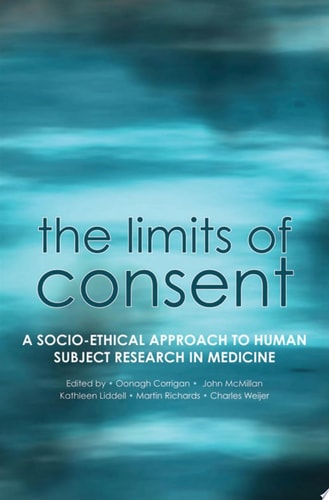
The Limits of Consent: A Socio-Ethical Approach to Human Subject Research in Medicine
0
0
As an Amazon Associate and affiliate partner, Menrva Books earns from qualifying purchases. Learn more
Author Description
Since its inception as an international principle to protect the welfare of patients and volunteers taking part in medical research, informed consent has become increasingly important within healthcare. Despite its ubiquitous status, there are a number of scholars who are beginning to question whether consent is adequate for contemporary biomedical research. The Limits of Consent considers a number of criticisms that have been levelled at the prominence given to autonomy, a central tenet underpinning the rationale for informed consent in Western bioethics. It raises questions about how quickly and easily this principle has been adopted, and how appropriate it is for those actively engaged in research. In the context of genetic research, for example, the individual's overriding right of autonomy to give consent to research could have huge implications for other members of their families.The Limits of Consent questions the assumption that informed consent protects or facilitates individual autonomy, and discusses empirical studies which suggest that gaining a truly informed consent can be difficult to achieve in practice. With the expectation of treatment and guidance from the physician, how much is the process of consent governed by social norms and expectations? The Limits of Consent focuses upon three principal areas within biomedical research: clinical trials, genetic research, and research with those who may have impaired capacity to consent. It is a truly multi-disciplinary book, incorporating perspectives from medicine, law, philosophy and sociology.The Limits of Consent is a fascinating exploration of the inadequacies of consent, and will appeal to those in the fields of bioethics, socio-legal studies, sociology, and health law. Policy makers, research ethics committee members, and those healthcare professionals with an interest in medical ethics, will also find the book of interest.
Menrva's Summary
THE THESIS
This book investigates whether the traditional framework of informed consent remains an adequate ethical safeguard for contemporary biomedical research. The authors, a multidisciplinary team of scholars in medicine, law, philosophy, and sociology, challenge the assumption that informed consent effectively protects individual autonomy. By examining the practical difficulties of achieving true consent, the text argues that current standards may be insufficient when faced with the complexities of modern genetic studies and clinical trials.
THE SCOPE MAP
What You Will Find
- Analysis of the role of autonomy in Western bioethics and its limitations in practice.
- Examination of informed consent challenges within clinical trials and genetic research.
- Discussion of ethical frameworks for research involving individuals with impaired capacity.
- Integration of empirical studies and socio-legal perspectives on physician-patient dynamics.
THE AUTHORITY PERSPECTIVE
Experts recognize this work as a significant multidisciplinary contribution to the field of bioethics. Readers frequently note the academic density of the prose, which serves as a foundational text for researchers, policy makers, and legal professionals interested in the evolution of medical ethics.
Page Count:
256
Publication Date:
2009-03-25
Publisher:
Oxford University Press
ISBN-10:
019923146X
ISBN-13:
9780199231461
Philosophy
Health Law
Sociology
Medical research
Medical Ethics
Bioethics
Medicine
Community Tags
Similar Books



Reader Comments
Share Your Thoughts
No comments yet. Be the first to share your thoughts!