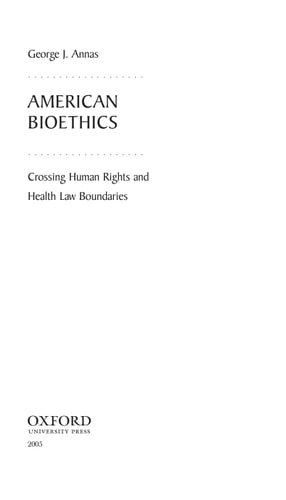
American Bioethics: Crossing Human Rights and Health Law Boundaries
0
0
As an Amazon Associate and affiliate partner, Menrva Books earns from qualifying purchases. Learn more
Author Description
Bioethics was "born in the USA" and the values American bioethics embrace are based on American law, including liberty and justice. This book crosses the borders between bioethics and law, but moves beyond the domestic law/bioethics struggles for dominance by exploring attempts to articulate universal principles based on international human rights. The isolationism of bioethics in the US is not tenable in the wake of scientific triumphs like decoding the human genome, and civilizational tragedies like international terrorism. Annas argues that by crossing boundaries which have artificially separated bioethics and health law from the international human rights movement, American bioethics can be reborn as a global force for good, instead of serving mainly the purposes of U.S. academics. This thesis is explored in a variety of international contexts such as terrorism and genetic engineering, and in U.S. domestic disputes such as patient rights and market medicine. The citizens of the world have created two universal codes: science has sequenced the human genome and the United Nations has produced the Universal Declaration of Human Rights. The challenge for American bioethics is to combine these two great codes in imaginative and constructive ways to make the world a better, and healthier, place to live.
Menrva's Summary
THE THESIS
This book investigates whether American bioethics can evolve from a domestic, isolationist framework into a global force by integrating international human rights law with health policy. George J. Annas, a prominent scholar in health law and human rights, utilizes a comparative analysis of U.S. legal precedents and international declarations to challenge the current insular nature of the field. He argues that the rapid advancement of biotechnology and the complexities of global security necessitate a shift toward universal principles that transcend national borders. By synthesizing the human genome project with the Universal Declaration of Human Rights, the author proposes a new paradigm for ethical governance in medicine.
THE SCOPE MAP
What You Will Find
- Analysis of the intersection between American health law and international human rights frameworks.
- Examination of ethical dilemmas in genetic engineering and biotechnology.
- Case studies regarding patient rights, market-based medicine, and the impact of international terrorism on health policy.
- A proposed methodology for reconciling scientific advancement with global human rights standards.
THE AUTHORITY PERSPECTIVE
Experts recognize this work as a critical intervention in the field of bioethics, noting its departure from traditional domestic-focused discourse. Readers frequently highlight the author's ability to bridge complex legal theory with practical, real-world applications in global health policy.
Page Count:
264
Publication Date:
2004-10-28
Publisher:
Oxford University Press
ISBN-10:
0195169492
ISBN-13:
9780195169492
United States
Medical
Law
Allied Health
Health Law
Legislation Medical
Medical Ethics
Human rights
Bioethics