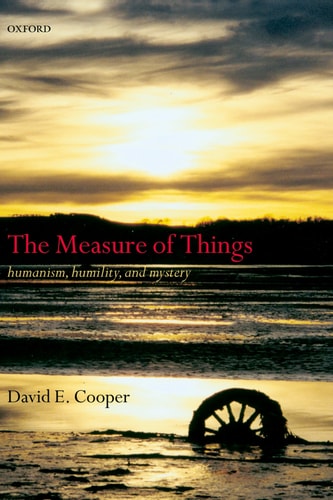
The Measure of Things: Humanism, Humility, and Mystery
0
0
As an Amazon Associate and affiliate partner, Menrva Books earns from qualifying purchases. Learn more
Author Description
Philosophers, both western and eastern, have long been divided between "humanists", for whom "man is the measure of things", and their opponents, who claim that there is a way, in principle knowable and describable, that the world anyway is, independent of human perspectives and interests.The early chapters of The Measure of Things chart the development of humanism from medieval times, through the Renaissance, Enlightenment and Romantic periods, to its most sophisticated, twentieth-century form, "existential humanism". Cooper does not identify this final position with that of any particular philosopher, though it is closely related to those of Heidegger, Merleau-Ponty and the later Wittgenstein. Among the earlier figures discussed are William of Ockham, Kant, Herder, Nietzsche and William James.Having rejected attempts by contemporary advocates of modest or non-metaphysical realism to dissolve the opposition between humanism and its "absolutist" rival, Cooper moves on to an adjudication of that rivality. Prompted by the pervasive rhetoric of hubris that the rivals direct against one another, he argues, in an original manner, that the rival positions are indeed guilty of lack of humility. Absolutists - whether defenders of "The Given" or scientific realists - exaggerate our capacity to ascend out of our "engaged" perspectives to an objective account of the world. Humanists, conversely, exaggerate our capacity to live without a sense of our subjection to a measure independent of our own perspectives.The only escape, Cooper maintains, from the impasse reached when humanism and absolutism are both rejected, lies in a doctrine of mystery. There is a reality independent of "the human contribution", but it is necessarily ineffable. Drawing in a novel way upon the Buddhist conception of "emptiness" and Heidegger's later writings, the final chapters defend the notion of mystery, distinguish the doctrine advanced from that of transcendental idealism, and propose that it is only through appreciation of mystery that measure and warrant may be provided for our beliefs and conduct.
Menrva's Summary
THE THESIS
This book investigates the philosophical impasse between humanism, which posits that human perspective defines reality, and absolutism, which claims an independent, objective world exists. David E. Cooper, a scholar of continental and comparative philosophy, examines the historical trajectory of these opposing views from medieval thought to twentieth-century existentialism. He argues that both positions suffer from a lack of humility, as they overstate human capacity either to define reality or to transcend human perspective entirely. To resolve this, Cooper proposes a doctrine of mystery, suggesting that while an independent reality exists, it remains fundamentally ineffable.
THE SCOPE MAP
What You Will Find
- Historical analysis of humanism from the medieval period through the Enlightenment and Romantic eras.
- Critical examination of existential humanism as represented by thinkers like Heidegger, Merleau-Ponty, and Wittgenstein.
- A comparative study integrating Western philosophical traditions with the Buddhist concept of emptiness.
- A proposed framework for understanding reality that rejects both scientific realism and traditional transcendental idealism.
THE AUTHORITY PERSPECTIVE
Scholars and students of philosophy frequently note the high level of academic rigor and the dense, nuanced prose employed by Cooper throughout his argument. Experts highlight this work as a significant contribution to comparative philosophy, particularly for its attempt to bridge Western existentialist thought with Eastern metaphysical concepts.
Page Count:
380
Publication Date:
2008-03-01
Publisher:
Oxford University Press
ISBN-10:
0199235988
ISBN-13:
9780199235988
Philosophy
Epistemology
Comparative Philosophy
Metaphysics
Humanism
Community Tags
Similar Books




Reader Comments
Share Your Thoughts
No comments yet. Be the first to share your thoughts!