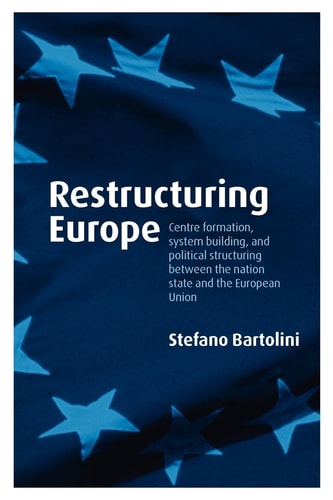
Restructuring Europe: Centre Formation, System Building, and Political Structuring between the Nation State and the European Union
0
0
As an Amazon Associate and affiliate partner, Menrva Books earns from qualifying purchases. Learn more
Author Description
This book focuses on the historical configuration of the territorial borders and functional boundaries of the European nation state. It presents integration as a process of boundary transcendence, redefinition, shift, and change that fundamentally alters the nature of the European states. Its core concern lies in the relationship between the specific institutional design of the new Brussels centre, the boundary redefinitions that result from its political production, and, finally, the consequences of these two elements on established and developing national European political structures. Integration is examined as a new historical phase in the development of Europe, characterized by a powerful trend toward legal, economic, and cultural de-differentiation after the five-century process of differentiation that led to the European system of nation states.Considering the EU as the formation of an enlarged territorial system, this work recovers some of the classic issues of political modernization theory: Is the EU an attempt at state formation? Is it an attempt at centre formation without nation building? Is it a process of centre formation without democratization?This work also seeks to sharpen the conceptual tools currently available to deal with processes of territorial enlargement and unification. It develops a theoretical framework for political structuring beyond the nation state, capable of linking all aspects of EU integration (inter-governmentalism, definition of rights, the "constitutionalization" of treaties, the tensions between the new territorial hierarchy and the nation states, etc.). The book adopts a "holistic" approach to integration, in the form of a theory from which hypotheses can be generated (even if it is not possible to test all of its components). This theoretical framework has three principal aims: to overcome a rigid distinction between domestic politics and international relations; to link actors' orientations, interests, and motivations with macro outcomes; and to relate structural profiles with dynamic processes of change.
Menrva's Summary
THE THESIS
This work investigates whether the European Union represents a new phase of state formation and how its institutional development impacts the established political structures of European nation states. Stefano Bartolini, a prominent scholar in political science, utilizes historical institutionalism and modernization theory to analyze the shift from a system of differentiated nation states to an integrated, de-differentiated territorial system. He argues that the EU functions as a new centre of power that necessitates a re-evaluation of traditional boundaries between domestic politics and international relations.
THE SCOPE MAP
What You Will Find
- Historical analysis of territorial borders and functional boundaries in Europe
- Theoretical framework for political structuring beyond the nation state
- Examination of the tension between Brussels-based institutional design and national sovereignty
- Discussion of the constitutionalization of treaties and the democratic deficit in integration
THE AUTHORITY PERSPECTIVE
Experts recognize this text as a rigorous, high-level contribution to the study of European integration and political modernization. Readers frequently note the academic density of the prose, which is intended for scholars and advanced students of political theory.
Page Count:
448
Publication Date:
2007-12-15
Publisher:
Oxford University Press
ISBN-10:
0199231877
ISBN-13:
9780199231874
History
Decentralization in government
Nation-state
Sociology
European Union
Comparative Government
Comparative Politics
International relations
Boundaries
Community Tags
Similar Books













Reader Comments
Share Your Thoughts
No comments yet. Be the first to share your thoughts!