
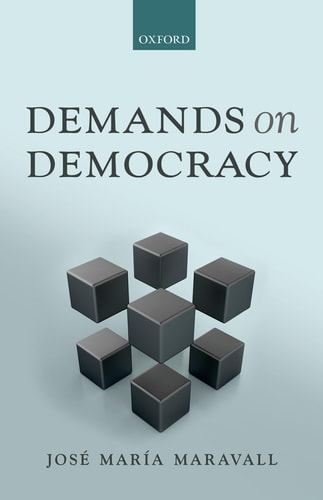
Demands on Democracy
0
0
As an Amazon Associate and affiliate partner, Menrva Books earns from qualifying purchases. Learn more
Author Description
Why are representative democracies extensively criticised, yet remain widely aspired to throughout the world? Many citizens believe that democratic politicians operate with privileged information that allows them autonomy from genuine democratic controls, a phenomenon reinforced by the opacity of internal party politics. In established democracies throughout the world there is a widespread perception that political parties compete for power, yet no significant differences exist between them. Moreover, economic inequalities are no longer redressed by national governments in a world where markets are dominant and relevant decisions have been taken out of domestic politics. Citizens vote, but their choice is hardly relevant. This has led to widespread demands for 'more' democracy. But what does that mean in practice? Can democracies introduce greater 'representation' of citizens' interests? Do politicians operate as an autonomous caste hardly challenged by voters? Has political competition become irrelevant for the welfare of people? Do citizens want more democracy in internal party politics? And turning beyond the nation-state, has the European Union changed the scope of policy alternatives and influenced the accountability of politicians? What have been the consequences of European integration for national democracies? In his major new book, José María Maravall examines these and many other questions fundamental to democratic politics in the 21st Century. In doing so he draws extensively on original empirical evidence from 21 OECD parliamentary democracies from 1945 to 2010, and 1,259 country/year observations focused on politics, representation, parties, inequality, economic policies, and the political and economic conditions of European integration.
Menrva's Summary
THE THESIS
This book investigates the paradox of why representative democracies face intense criticism while remaining globally sought after, specifically questioning how political autonomy and economic inequality impact democratic accountability. José María Maravall, a distinguished political scientist, utilizes a rigorous empirical framework to analyze the tension between citizen expectations and the realities of modern governance. By examining the structural constraints of party politics and the influence of global markets, he evaluates whether current democratic systems can effectively represent the interests of their constituents.
THE SCOPE MAP
What You Will Find
- Empirical analysis of 21 OECD parliamentary democracies spanning 1945 to 2010.
- A dataset comprising 1,259 country/year observations regarding political representation and economic policy.
- Evaluation of the impact of European integration on national political accountability.
Scope Limits
- The analysis focuses primarily on established parliamentary democracies and does not address non-democratic or developing regimes.
- The study does not provide prescriptive policy solutions but rather focuses on the analytical mechanics of democratic performance.
THE AUTHORITY PERSPECTIVE
Experts recognize this work as a significant contribution to the study of comparative politics due to its extensive use of longitudinal data. Readers frequently note the academic density of the prose, which makes it a foundational text for scholars and students interested in the mechanics of modern representative government.
Page Count:
147
Publication Date:
2016-01-01
Publisher:
OUP Oxford
ISBN-10:
0191084301
ISBN-13:
9780191084300
Government
Democracy
Public Policy
European Union
Comparative Politics
Community Tags
Other Editions(3)

Similar Books




Reader Comments
Share Your Thoughts
No comments yet. Be the first to share your thoughts!