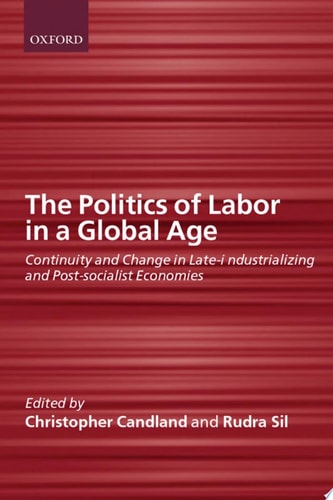
The Politics of Labor in a Global Age: Continuity and Change in Late-Industrializing and Post-Socialist Economies
0
0
As an Amazon Associate and affiliate partner, Menrva Books earns from qualifying purchases. Learn more
Author Description
One of the first works to analyze and compare recent shifts in patterns of industrial relations across late-industrializing and post-socialist economies, this volume features original, timely essays on distinct responses to common economic pressures associated with "globalization." As unions in late-developing countries engaged in economic liberalization, and as unions in post-socialist economies cope with the break down of command economies, these pressures have grown. The authors also reveal that globalization has weakened organized labor, yet they explain that distinct labor institutions persist despite similar economic adjustment measures. Globalization may even facilitate variation in the pattern of labor relations at national, local, and workplace levels, and within and across late-industrializing and post-socialist settings.
Menrva's Summary
THE THESIS
This volume investigates how globalization influences labor relations and institutional continuity within late-industrializing and post-socialist economies. Christopher Candland and Rudra Sil curate a collection of essays that examine the divergent responses of labor unions to economic liberalization and the collapse of command-based systems. By analyzing specific national and workplace contexts, the authors argue that while global economic pressures exert a weakening effect on organized labor, local institutional frameworks continue to dictate unique patterns of adaptation and resistance.
THE SCOPE MAP
What You Will Find
- Comparative analysis of industrial relations in late-industrializing and post-socialist nations.
- Examination of union responses to economic liberalization and market transition.
- Case studies focusing on national, local, and workplace-level labor dynamics.
- Theoretical framework addressing the persistence of distinct labor institutions under global economic pressure.
THE AUTHORITY PERSPECTIVE
Experts identify this work as a significant comparative study that challenges the assumption of uniform global labor decline. Scholars frequently cite the text for its nuanced approach to institutional persistence in the face of widespread economic change.
Page Count:
376
Publication Date:
2001-11-29
Publisher:
Oxford University Press
ISBN-10:
0199241147
ISBN-13:
9780199241149
Economics
Sociology
Industrial Relations
Globalization
Labor Studies
Post-communism
Community Tags
Similar Books