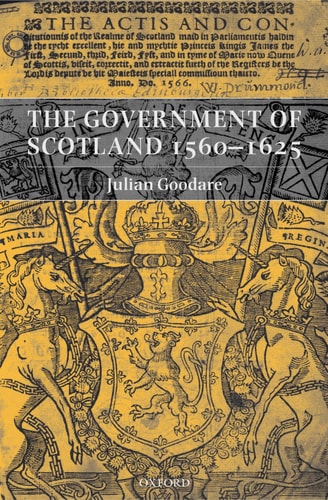
The Government of Scotland 1560-1625
0
0
As an Amazon Associate and affiliate partner, Menrva Books earns from qualifying purchases. Learn more
Author Description
In The Government of Scotland 1560-1625 Goodare shows how Scotland was governed during the transition from Europe's decentralized medieval realms to modern sovereign states. The expanding institutions of government - crown, parliament, privy council, local courts - are detailed, but the book is structured around an analysis of governmental processes. A new framework is offered for understanding the concept of 'centre and localities': centralization happened in the localities.Various interest groups participated in government and influenced its decisions. The nobility, in particular, exercised influence at every level. There was also English influence, both before and after the union of crowns in 1603. It is argued that the crown's continuing involvement after 1603 shows the common idea of 'absentee monarchy' to be misconceived. Goodare also pays particular attention to the harsh impact of government in the Highlands - where the chiefs were not full members of 'Scottish' political society - and on the common people - who were also excluded from normal political participation.
Menrva's Summary
THE THESIS
This work investigates how the Scottish state evolved and functioned during the critical transition period between 1560 and 1625. Julian Goodare, a specialist in early modern Scottish history, utilizes extensive archival research to challenge traditional narratives regarding centralization and the nature of the monarchy. He argues that the Scottish government was a complex, interactive system where power was negotiated between the crown, the nobility, and local institutions rather than imposed from a singular center.
THE SCOPE MAP
What You Will Find
- Analysis of the structural evolution of the crown, parliament, and privy council.
- A re-evaluation of the 'absentee monarchy' theory following the 1603 union of crowns.
- Examination of the political exclusion of the common people and Highland chiefs.
- A framework for understanding how centralization occurred within local administrative spheres.
THE AUTHORITY PERSPECTIVE
Historians recognize this text as a foundational study for understanding the administrative mechanics of early modern Scotland. Scholars frequently cite Goodare's work for its rigorous challenge to established myths regarding the impact of the union of crowns on Scottish governance.
Page Count:
352
Publication Date:
2004-12-16
Publisher:
Oxford University Press
ISBN-10:
0199243549
ISBN-13:
9780199243549
History
Scottish History
Politics & Government
European History
Government
Community Tags
Other Editions(2)
Similar Books