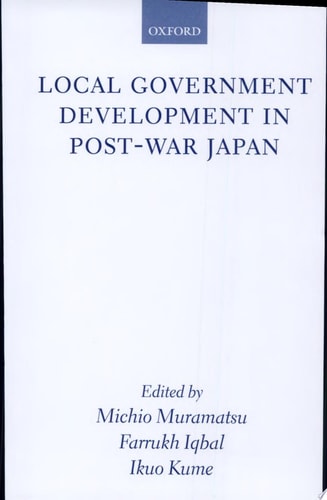
Local Government Development in Postwar Japan
0
0
As an Amazon Associate and affiliate partner, Menrva Books earns from qualifying purchases. Learn more
Author Description
This book provides an updated and comprehensive review of the development of Japan's local government system over the past half century. It corrects the view that Japan is over-centralized by providing examples of expanding local government autonomy over time. Such examples include the success of local initiatives in anti-pollution, healthcare, and welfare policies. It also shows that gradual and controlled decentralization, as practised in Japan, has helped avoid coordination problems while providing time and resources for local governments to build capacity to undertake development projects, programmes, and planning. In so doing, it offers an alternative to the view that maximum autonomy quickly granted is the best way to develop local governments.
Menrva's Summary
THE THESIS
This book investigates the evolution of Japan's local government system to determine whether the prevailing narrative of extreme centralization accurately reflects the nation's postwar administrative development. The authors, Farrukh Iqbal, Ikuo Kume, and Michio Muramatsu, utilize historical data and policy analysis to challenge the assumption that rapid, total decentralization is the only viable path for development. By examining the gradual shift toward local autonomy, they argue that Japan's controlled approach successfully mitigated coordination failures while simultaneously fostering the institutional capacity necessary for effective local governance.
THE SCOPE MAP
What You Will Find
- A comprehensive review of Japanese local government policy spanning the last fifty years.
- Analysis of successful local initiatives in anti-pollution, healthcare, and welfare sectors.
- A comparative framework evaluating the efficacy of gradual decentralization versus immediate autonomy.
- Evidence-based assessment of how local governments built administrative capacity through controlled resource allocation.
THE AUTHORITY PERSPECTIVE
Experts recognize this text as a critical contribution to the study of Japanese political economy and administrative reform. Readers frequently note the clarity with which the authors dismantle common misconceptions regarding the rigidity of Japan's central-local government relations.
Page Count:
272
Publication Date:
2002-02-07
Publisher:
Oxford University Press
ISBN-10:
0199248281
ISBN-13:
9780199248285
History
Japan
Government
Public Administration
Community Tags
Similar Books