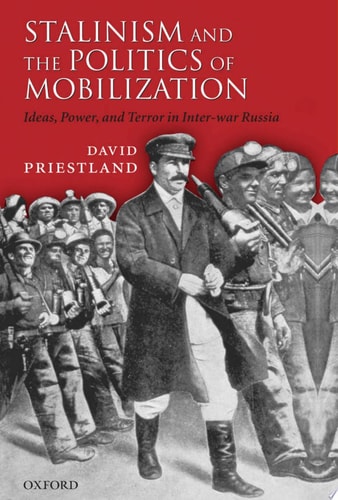
Stalinism and the Politics of Mobilization
0
0
As an Amazon Associate and affiliate partner, Menrva Books earns from qualifying purchases. Learn more
Author Description
Stalin's Terror of 1937-8 is one of the most extraordinary events of the twentieth century. His seemingly irrational attack on the military, technical, and political élite on the eve of war, precisely the time when he needed them most, remains difficult to understand. Stalinism and the Politics of Terror provides a new explanation of the political violence of the late 1930s by examining the thinking of Stalin and his allies, and placing it in the broader context of Bolshevik ideas since 1917.
Menrva's Summary
THE THESIS
This work investigates the underlying political logic and ideological motivations that drove Stalin to initiate the Great Terror against his own elite during the late 1930s. David Priestland, a historian specializing in Soviet politics, utilizes archival research and analysis of Bolshevik discourse to argue that the violence was not merely irrational, but a product of specific ideological commitments regarding mobilization and class struggle that evolved from the 1917 revolution. By situating these actions within the broader framework of Soviet political culture, the author provides a structured explanation for why the regime targeted its own technical and military leadership on the precipice of global conflict.
THE SCOPE MAP
What You Will Find
- Analysis of the Great Terror of 1937-1938 and its impact on the Soviet political and military elite.
- Examination of Bolshevik ideological development from 1917 through the late 1930s.
- Investigation into the internal political dynamics and decision-making processes of Stalin and his inner circle.
- Evaluation of the concept of mobilization as a primary driver of state-sanctioned violence.
THE AUTHORITY PERSPECTIVE
Scholars and historians frequently cite this text as a significant contribution to the understanding of Stalinist political culture and the internal logic of the Soviet state. Readers often note the academic density of the prose, which provides a rigorous, evidence-based challenge to earlier interpretations of the Terror as purely irrational.
Page Count:
487
Publication Date:
2007-03-29
Publisher:
Oxford University Press
ISBN-10:
0199245134
ISBN-13:
9780199245130
History
Soviet Union
Soviet History
Communism
Community Tags
Similar Books