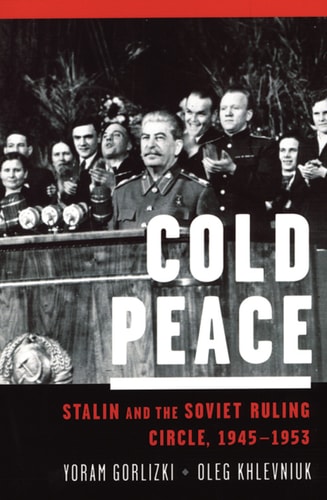
Cold Peace: Stalin and the Soviet Ruling Circle, 1945-1953
0
0
As an Amazon Associate and affiliate partner, Menrva Books earns from qualifying purchases. Learn more
Author Description
Following his country's victory over Nazi Germany, Joseph Stalin was widely hailed as a great wartime leader and international statesman. Unchallenged on the domestic front, he headed one of the most powerful nations in the world. Yet, in the period from the end of World War II until his death, Stalin remained a man possessed by his fears. In order to reinforce his despotic rule in the face of old age and uncertain health, he habitually humiliated and terrorized members of his inner circle. He had their telephones bugged and even forced his deputy, Viacheslav Molotov, to betray his own spouse as a token of his allegiance. Often dismissed as paranoid and irrational, Stalin's behavior followed a clear political logic, contend Yoram Gorlizki and Oleg Khlevniuk. Stalin's consistent and overriding goal after the war was to consolidate the Soviet Union's status as a superpower and, in the face of growing decrepitude, to maintain his own hold as leader of that power. To that end, he fashioned a system of leadership that was at once patrimonial-repressive and quite modern. While maintaining informal relations based on personal loyalty at the apex of the system, in the postwar period Stalin also vested authority in committees, elevated younger specialists, and initiated key institutional innovations with lasting consequences. Close scrutiny of Stalin's relationships with his most intimate colleagues also shows how, in the teeth of periodic persecution, Stalin's deputies cultivated informal norms and mutual understandings which provided the foundations for collective rule after his death. Based on newly released archival documents, including personal correspondence, drafts of Central Committee paperwork, new memoirs, and interviews with former functionaries and the families of Politburo members, this book will appeal to all those interested in Soviet history, political history, and the lives of dictators. Cold Peace was a CHOICE Outstanding Academic Title for 2005.
Menrva's Summary
THE THESIS
This book investigates how Joseph Stalin maintained absolute control over the Soviet Union between 1945 and 1953 while simultaneously modernizing the state's administrative apparatus. Authors Oleg Khlevniuk and Yoram Gorlizki, both established scholars of Soviet history, argue that Stalin's postwar behavior was not merely the result of irrational paranoia but a calculated political strategy. By analyzing the interplay between personal terror and institutional innovation, the authors demonstrate how Stalin balanced patrimonial rule with the development of a modern bureaucratic system.
THE SCOPE MAP
What You Will Find
- Analysis of the Soviet Politburo's internal dynamics and decision-making processes.
- Examination of Stalin's use of committees and younger specialists to manage state affairs.
- Evidence derived from newly released archival documents, personal correspondence, and Central Committee records.
Scope Limits
- The study focuses primarily on the inner circle of leadership rather than broader social or economic history of the Soviet populace.
- It does not provide a comprehensive biography of Stalin's entire life, concentrating strictly on the 1945-1953 period.
THE AUTHORITY PERSPECTIVE
Historians and political scientists frequently cite this work as a foundational text for understanding the transition from Stalinist autocracy to collective leadership. Readers often note the academic density of the prose, which relies heavily on primary source analysis to challenge long-standing myths about the Soviet ruling circle.
Page Count:
248
Publication Date:
2004-01-01
Publisher:
Oxford University Press
ISBN-10:
0190290145
ISBN-13:
9780190290146
History
Biography
European History
Soviet Union
Soviet History
20th Century
Political Leadership
Community Tags
Other Editions(2)

Similar Books



Reader Comments
Share Your Thoughts
No comments yet. Be the first to share your thoughts!