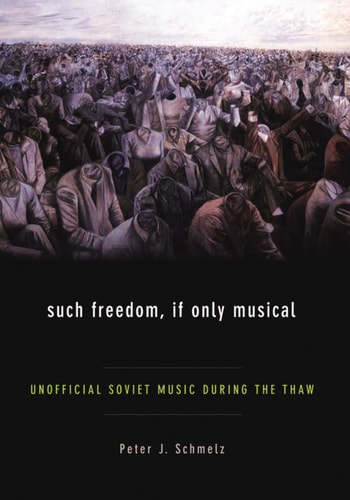
Such Freedom, If Only Musical: Unofficial Soviet Music During the Thaw
0
0
As an Amazon Associate and affiliate partner, Menrva Books earns from qualifying purchases. Learn more
Author Description
Following Stalin's death in 1953, during the period now known as the Thaw, Nikita Khrushchev opened up greater freedoms in cultural and intellectual life. A broad group of intellectuals and artists in Soviet Russia were able to take advantage of this, and in no realm of the arts was this perhaps more true than in music. Students at Soviet conservatories were at last able to use various channels--many of questionable legality--to acquire and hear music that had previously been forbidden, and visiting performers and composers brought young Soviets new sounds and new compositions. In the 1960s, composers such as Andrey Volkonsky, Edison Denisov, Alfred Schnittke, Arvo Pärt, Sofia Gubaidulina, and Valentin Silvestrov experimented with a wide variety of then new and unfamiliar techniques ranging from serialism to aleatory devices, and audiences eager to escape the music of predictable sameness typical to socialist realism were attracted to performances of their new and unfamiliar creations. This "unofficial" music by young Soviet composers inhabited the gray space between legal and illegal. Such Freedom, If Only Musical traces the changing compositional styles and politically charged reception of this music, and brings to life the paradoxical freedoms and sense of resistance or opposition that it suggested to Soviet listeners. Author Peter J. Schmelz draws upon interviews conducted with many of the most important composers and performers of the musical Thaw, and supplements this first-hand testimony with careful archival research and detailed musical analyses. The first book to explore this period in detail, Such Freedom, If Only Musical will appeal to musicologists and theorists interested in post-war arts movements, the Cold War, and Soviet music, as well as historians of Russian culture and society.
Menrva's Summary
THE THESIS
This book investigates how Soviet composers navigated the shifting political landscape of the post-Stalin Thaw to create 'unofficial' music that challenged the aesthetic constraints of socialist realism. Author Peter J. Schmelz, a musicologist specializing in 20th-century Russian music, utilizes a combination of primary source interviews with key composers and rigorous archival research to document this period. He argues that the emergence of avant-garde techniques served as a form of cultural resistance, occupying a precarious gray space between state-sanctioned art and illicit activity.
THE SCOPE MAP
What You Will Find
- Analysis of compositional techniques including serialism and aleatory devices.
- Historical documentation of the Soviet musical climate from 1953 through the 1960s.
- First-hand accounts from composers such as Alfred Schnittke, Arvo Pärt, and Sofia Gubaidulina.
- Examination of the reception of unofficial music by Soviet audiences.
Scope Limits
- The text focuses primarily on the musical avant-garde rather than the broader spectrum of popular or folk music.
- It does not provide an exhaustive biography of every composer mentioned, focusing instead on their contributions during the Thaw.
THE AUTHORITY PERSPECTIVE
Experts recognize this work as a foundational text for understanding the intersection of Cold War politics and artistic innovation in the Soviet Union. Readers frequently note the academic density of the prose, which provides a high level of detail for musicologists and historians alike.
Page Count:
408
Publication Date:
2009-01-01
Publisher:
Oxford University Press
ISBN-10:
0190450991
ISBN-13:
9780190450991
History
Cold War
Political Aspects
Music History
Russian History
Criticism history
Soviet Union
Soviet History
European History
Humanities
Musicology