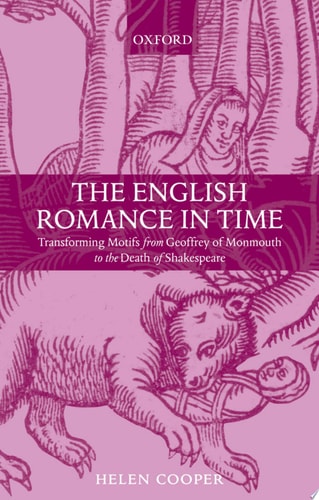
The English Romance in Time: Transforming Motifs from Geoffrey of Monmouth to the Death of Shakespeare
0
0
As an Amazon Associate and affiliate partner, Menrva Books earns from qualifying purchases. Learn more
Author Description
The English Romance in Time is a study of English romance across the Middle Ages and the Renaissance. It explores romance motifs - quests and fairy mistresses, passionate heroines and rudderless boats and missing heirs - from the first emergence of the genre in French and Anglo-Norman in the twelfth century down to the early seventeenth. This is a continuous story, since the same romances that constituted the largest and most sophisticated body of secular fiction in the Middle Ages went on to enjoy a new and vibrant popularity at all social levels in black-letter prints as the pulp fiction of the Tudor age. This embedded culture was reworked for political and Reformation propaganda and for the 'writing of England', as well as providing a generous reservoir of good stories and dramatic plots. The different ways in which the same texts were read over several centuries, or the same motifs shifted meaning as understanding and usage altered, provide a revealing and sensitive measure of historical and cultural change. The book accordingly looks at those processes of change as well as at how the motifs themselves work, to offer a historical semantics of the language of romance conventions. It also looks at how politics and romance intersect - the point where romance comes true.The historicizing of the study of literature is belatedly leading to a wider recognition that the early modern world is built on medieval foundations. This book explores both the foundations and the building. Similarly, generic theory, which previously tended to operate on transhistorical assumptions, is now acknowledging that genre interacts crucially with cultural context - with changing audiences and ideologies and means of dissemination. The generation into which Spenser and Shakespeare were born was the last to be brought up on a wide range of medieval romances in their original forms, and they could therefore exploit their generic codings in new texts aimed at both elite and popular audiences. Romance may since then have lost much of its cultural centrality, but the universal appeal of these same stories has continued to fuel later works from Bunyan's Pilgrim's Progress to C.S. Lewis and Tolkien.
Menrva's Summary
THE THESIS
This study investigates how English romance motifs evolved and maintained cultural relevance from the twelfth-century works of Geoffrey of Monmouth through the early seventeenth century. Professor Helen Cooper, a distinguished scholar in medieval and early modern literature, utilizes a historical-semantic approach to analyze how these narratives functioned as both popular entertainment and political instruments. By tracing the continuity of specific tropes, she argues that the early modern literary landscape, including the works of Spenser and Shakespeare, is fundamentally constructed upon medieval generic foundations.
THE SCOPE MAP
What You Will Find
- Analysis of recurring romance motifs such as quests, fairy mistresses, and missing heirs.
- Examination of the transition from medieval manuscript culture to Tudor-era black-letter print culture.
- Exploration of the intersection between romance conventions and Reformation-era political propaganda.
- Theoretical framework regarding the interaction between genre evolution and shifting cultural ideologies.
THE AUTHORITY PERSPECTIVE
Scholars recognize this work as a significant contribution to the historicizing of literary studies, particularly regarding the continuity between medieval and early modern texts. Readers frequently note the academic density of the prose and the author's meticulous attention to the shifting semantics of generic conventions.
Page Count:
560
Publication Date:
2004-08-19
Publisher:
Oxford University Press
ISBN-10:
0199248869
ISBN-13:
9780199248865
Genre Theory
Literary Criticism
Community Tags
Similar Books





Reader Comments
Share Your Thoughts
No comments yet. Be the first to share your thoughts!