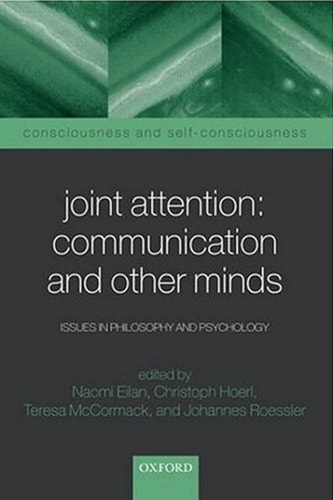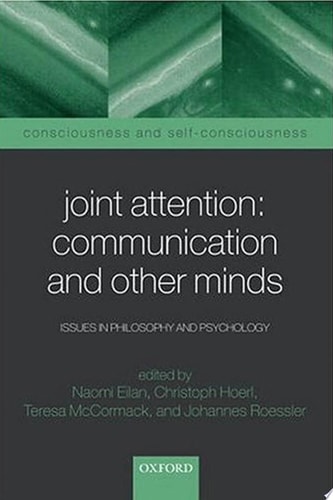
Joint Attention: Communication and Other Minds: Issues in Philosophy and Psychology
0
0
As an Amazon Associate and affiliate partner, Menrva Books earns from qualifying purchases. Learn more
Author Description
Some time around their first birthday, children begin to engage in "triadic" interactions, i.e. interactions with adults that turn specifically on both child and adult jointly attending to an object in their surroundings. Recognized as a developmental milestone amongst psychologists for some time, joint attention has recently also started to attract the attention of philosophers. This volume brings together, for the first time, psychological and philosophical perspectives on the nature and significance of joint attention. Original contributions by leading researchers in both disciplines explore the idea that joint attention has a key foundational role to play in the emergence of communicative abilities, psychological understanding, and, possibly, in the very capacity for objective thought.Contributors:Dare Baldwin, Josep Call, John Campbell, Naomi Eilan, Fabio Franco, Juan-Carlos Gomez, Jane Heal, R. Peter Hobson, Christoph Hoerl, Sue Leekam, Teresa McCormack, Christopher Peacocke, Vasudevi Reddy, Johannes Roessler, Mark A. Sabbagh, Michael Tomasello, Amanda L. Woodward.
Menrva's Summary
THE THESIS
This volume investigates the foundational role of joint attention in the development of human communication, psychological understanding, and the capacity for objective thought. The editors, a multidisciplinary team of philosophers and psychologists, curate a collection of original essays that bridge the gap between empirical developmental research and conceptual philosophical inquiry. By synthesizing these two fields, the text examines how triadic interactions—where a child and adult focus on a shared object—serve as a critical milestone in cognitive growth. The contributors utilize both experimental data and theoretical frameworks to argue that joint attention is not merely a social behavior but a prerequisite for higher-order mental processes.
THE SCOPE MAP
What You Will Find
- Analysis of triadic interactions in early childhood development.
- Philosophical arguments regarding the emergence of objective thought.
- Empirical studies on the link between joint attention and communicative abilities.
- Interdisciplinary perspectives from leading researchers in psychology and philosophy.
THE AUTHORITY PERSPECTIVE
Experts recognize this volume as a significant interdisciplinary resource that successfully bridges the divide between developmental psychology and philosophy of mind. Readers frequently note the academic density of the prose, which is intended for researchers and advanced students in cognitive science.
Page Count:
344
Publication Date:
2005-05-05
Publisher:
Oxford University Press
ISBN-10:
0199245649
ISBN-13:
9780199245642
Philosophy
Psychology
Developmental Psychology
Community Tags
Similar Books