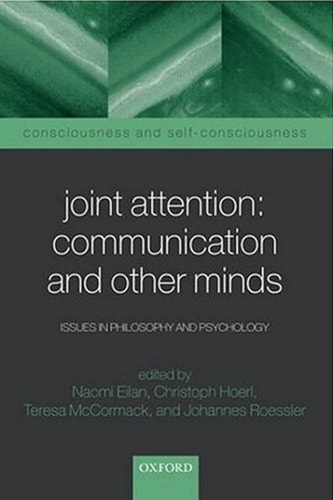
Joint Attention: Communication and Other Minds: Issues in Philosophy and Psychology
0
0
As an Amazon Associate and affiliate partner, Menrva Books earns from qualifying purchases. Learn more
Author Description
An international team of psychologists and philosophers present the latest research into the fascinating cognitive phenomenon of 'joint attention'. Some time around their first birthday most infants begin to engage in a behaviour that is designed to bring it about - say, by means of pointing or gaze-following - that their own and another person's attention are focused on the same object. Described as manifestations of an emerging capacity for joint attention, such triangulations between infant, adult and the world are often treated as a developmental landmark and have become the subject of intensive research among developmentalists and primatologists over the past decade. More recently, work on joint attention has also begun to attract the attention of philosophers. Fuelling researchers' interest in all these disciplines is the intuition that joint attention plays a foundational role in the emergence of communicative abilities, in children's developing understanding of the mind and, possibly, in the very capacity for objective thought. This book brings together, for the first time, philosophical and psychological perspectives on the nature and significance of the phenomenon, addressing issues such as: How should we explain the kind of mutual openness that joint attention seems to involve, i.e. the sense in which both child and adult are aware that they are attending to the same thing? What sort of grip on one's own and other people's mental states does such awareness involve, and how does it relate to later-emerging 'theory of mind' abilities? In what sense, if any, is the capacity to engage in joint attention with others unique to humans? How should we explain autistic children's seeming incapacity to engage in joint attention? What role, if any, does affect play in the achievement of joint attention? And what, if any, is the connection between participation in joint attention and grasp of the idea of an objective world? The book also contains an introductory chapt
Menrva's Summary
THE THESIS
This volume investigates the cognitive and philosophical foundations of joint attention, specifically examining how the capacity to share focus with others influences the development of communication and an understanding of other minds. The editors, Christoph Hoerl, Naomi Eilan, and Teresa McCormack, curate a collection of essays from an international cohort of psychologists and philosophers. The work synthesizes empirical data from developmental studies and primatology with conceptual analysis to determine if joint attention serves as a prerequisite for objective thought and theory of mind.
THE SCOPE MAP
What You Will Find
- Analysis of the mutual openness involved in infant-adult gaze-following and pointing.
- Comparative studies on the uniqueness of joint attention in human versus non-human primates.
- Theoretical frameworks linking joint attention to the development of 'theory of mind'.
- Investigations into the role of affect and the implications of autism spectrum conditions on joint attention.
Scope Limits
- The text does not provide a clinical manual for therapeutic intervention in developmental disorders.
- It does not offer an exhaustive history of all psychological theories regarding social cognition.
THE AUTHORITY PERSPECTIVE
Experts recognize this collection as a significant interdisciplinary resource for those studying the intersection of philosophy and developmental psychology. Readers frequently note the academic density of the prose, which is intended for researchers and advanced students in the cognitive sciences.
Page Count:
344
Publication Date:
2005-01-01
Publisher:
Oxford University Press
ISBN-10:
0191514306
ISBN-13:
9780191514302
Psychology
Philosophy
Developmental Psychology
Mind & Body
Neuroscience
Family & Consumer Sciences
Community Tags
Similar Books













Reader Comments
Share Your Thoughts
No comments yet. Be the first to share your thoughts!