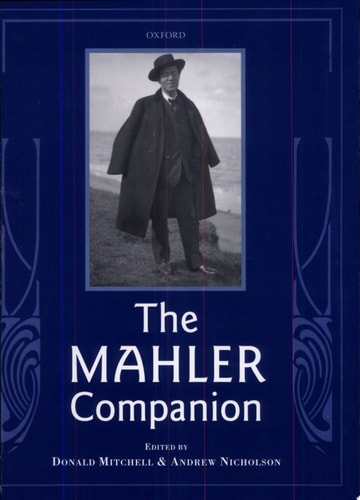
The Mahler Companion
0
0
As an Amazon Associate and affiliate partner, Menrva Books earns from qualifying purchases. Learn more
Author Description
The Mahler Companion consists of a collection of original essays on Mahler written especially for the occasion by Mahler specialists from around the world. It addresses all parts of his life and work-- symphonies, songs and song-cycles (each of which is discussed individually), his conducting activities, compositional habits, and aesthetic development--and sets these within the cultural and political context of his time. In addition, it responds to the global spread of this remarkable composer's music, and an almost universal fascination with it, by attempting to give an account of the reception of Mahler's music in many of the countries in which it eventually came to flourish, eg. Holland, France, Japan, Russia, England, and the United States. This particular series of chapters reveals that the 'Mahler Phenomenon' earned its description principally in the years after the Second World War, but also that the Mahler revival was already well under way pre-war, perhaps especially in England and the States, and most surprisingly of all, Japan.The selection of contributors, who between them cover all Mahler's musical output, shows that here too this volume significantly crosses national boundaries. The very diverse approaches, analyses and commentaries, amply illustrated with music examples, are evidence of the uniquely rich and complex character of a music that spans more than one culture and more than one century. The volumes includes the most significant and up-to-date Mahler research and debate, and illumines some hitherto unexplored areas of Mahler's life eg. his visit to London in 1892, his sculptor daughter, Anna, and the hall in which the Seventh Symphony was first performed in Prague in 1908.It has often been claimed that Mahler, born in 1860, was in fact a prophet of much that was to come in the 20th century. His later works undeniably anticipate, often with dazzling virtuosity, many of the principal techniques and aesthetics of the new century, only the first decade of which he lived to see. Small wonder that among his earliest admirers was a collective of some of the most important and innovative composers of our time, Schoenberg, Berg, and Webern. Their successors (Copland, Shostakovich, and Britten, to name a few) were to range across contrasting cultures and national frontiers.Drawing on the best resources and the most up-to-date information about the composer, this volume fulfils the need in Mahler literature for a genuinely comprehensive guide to the composer and will be the authoritative guide for Mahler enthusiasts for years to come.
Menrva's Summary
THE THESIS
This collection of essays investigates the multifaceted life, compositional output, and global reception of Gustav Mahler to determine his role as a pivotal figure in 20th-century music. Edited by Andrew Nicholson and Donald Mitchell, the volume aggregates research from international specialists to contextualize Mahler's symphonies, songs, and conducting career within the cultural and political frameworks of his era. The authors argue that Mahler’s work serves as a bridge between 19th-century traditions and the aesthetic innovations of the modern age.
THE SCOPE MAP
What You Will Find
- Comprehensive analysis of Mahler's symphonies, song cycles, and compositional techniques.
- Historical documentation regarding Mahler's conducting activities and professional life.
- Comparative studies on the international reception of Mahler's music in countries including Japan, Russia, and the United States.
- Examination of previously unexplored biographical details, such as his 1892 London visit and family history.
- Musicological commentary illustrated with specific examples from the scores.
THE AUTHORITY PERSPECTIVE
Experts and musicologists regard this volume as a foundational reference for understanding the breadth of Mahler's influence. Readers frequently note the academic density of the prose, which serves as a primary resource for both students and scholars of late Romantic music.
Page Count:
647
Publication Date:
2002-06-27
Publisher:
Oxford University Press
ISBN-10:
0199249652
ISBN-13:
9780199249657
Biography
Music
Essays
Criticism history
Music History
Community Tags
Other Editions(2)

Similar Books







Reader Comments
Share Your Thoughts
No comments yet. Be the first to share your thoughts!