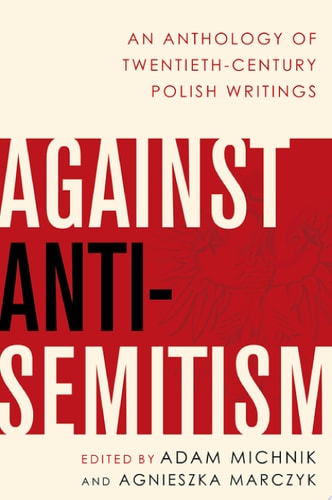
Against Anti-Semitism: An Anthology of Twentieth-Century Polish Writings
0
0
As an Amazon Associate and affiliate partner, Menrva Books earns from qualifying purchases. Learn more
Author Description
Poland's relationship with its Jewish population has long been a subject of often agonizing debate. In September 1939, there were approximately 3.3 million Jews living in Poland, the largest population in Europe. In May 1945, between 40,000 and 60,000 remained. Most of the Nazi death camps had been located on Polish soil. The intertwined issues of wartime complicity and victimhood haunt Poland to this day, complicated by the unavoidable fact that anti-Semitism in Poland existed well before the outbreak of the Second World War, and has existed long after it. The deadly Kielce Pogrom in July 1946 appalled the world, since its victims were precisely those Jews who had miraculously survived annihilation. And while with the years physical violence against Jews diminished-if only because there were not many at whom to direct it-anti-Semitism has remained no less virulent, emerging as a force in Polish politics, religious life, and in society at large. A study undertaken in 2002 determined that one in nine Poles believed the Jews collectively responsible for the crucifixion of Christ. One in four claimed that Jews were secretly plotting to rule the world.Is anti-Semitism integral to Polish identity? Nowhere has this question been more the cause of soul-searching than in Poland itself. In this volume, Adam Michnik, one of Poland's foremost writers and intellectuals, and Agnieszka Marczyk have brought together the most significant essays of the twentieth century written by prominent Poles on Polish anti-Semitism, including by such writers and intellectuals as Czeslaw Milosz, Leszek Kolakowski, Jerzy Andrzejewski, and Tadeusz Mazowiecki. Taken from a three-volume original Polish edition, 3,000 pages in length and containing 320 entries, the essays, most of which have been translated into English here for the first time by Marczyk, resonate with Michnik's central argument-that anti-Semitism is not a given of Polish culture. It has been consistently challenged and rejected.
Menrva's Summary
THE THESIS
This anthology investigates whether anti-Semitism is an inherent component of Polish identity by examining twentieth-century intellectual discourse on the subject. Adam Michnik, a prominent Polish intellectual, and translator Agnieszka Marczyk curate a selection of essays from a massive three-volume Polish original to argue that anti-Semitism is not a fixed cultural trait. The collection highlights a consistent tradition of Polish thinkers who have actively challenged and rejected xenophobic ideologies throughout the century.
THE SCOPE MAP
What You Will Find
- A curated selection of essays from 320 original entries spanning the twentieth century.
- Perspectives from notable Polish intellectuals including Czeslaw Milosz, Leszek Kolakowski, and Tadeusz Mazowiecki.
- Historical context regarding the Kielce Pogrom and the shifting demographics of the Polish Jewish population.
Scope Limits
- The volume does not provide a comprehensive history of the Holocaust itself, focusing instead on the internal Polish intellectual response to anti-Semitism.
- It does not cover anti-Semitic discourse outside of the Polish cultural and political sphere.
THE AUTHORITY PERSPECTIVE
Experts recognize this anthology as a critical resource for understanding the internal debates within Polish society regarding its historical relationship with Jewish citizens. Readers often note the academic density of the prose, which serves as a foundational text for those seeking to understand the complexities of Polish national identity and moral accountability.
Page Count:
419
Publication Date:
2017-01-01
Publisher:
Oxford University Press
ISBN-10:
0190624531
ISBN-13:
9780190624538
History
Sociology
English
English & College Success
Criticism history
Essays
Anti-Semitism
European History
Jewish History
Polish Studies
Community Tags
Similar Books





Reader Comments
Share Your Thoughts
No comments yet. Be the first to share your thoughts!