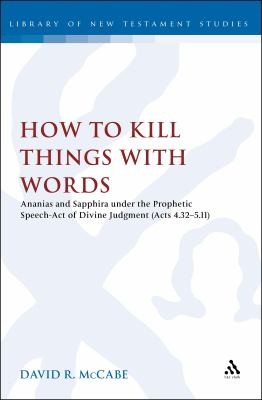
How to Kill Things with Words: Ananias and Sapphira Under the Prophetic Speech Act of Divine Judgment (Acts 4:32-5:11)
0
0
As an Amazon Associate and affiliate partner, Menrva Books earns from qualifying purchases. Learn more
Author Description
This work studies the literary and socio-discursive contexts of 'the Ananias and Sapphira episode' in Acts as a narrative illustrating the negative-ethos of community goods. This work examines the dynamics of the Ananias and Sapphira episode in Acts and its role in the narrative of Luke-Acts. McCabe locates the passage within its literary context, and emphasizes the manner in which it is embedded in a discourse on the life of the Christian community expressed through shared goods. Utilizing Speech-Act Theory, McCabe argues that Peter's words, divinely sanctioned, directly execute the divine judgment upon the couple. This is argued by appealing to the social processes and conventions of language-use within the context of a 'community-of-goods' discourse as present in the Lukan narrative. McCabe appeals to the conventions deployed in the narrative world of Luke-Acts which undergird the efficacy of prophetic speech to effect divine judgment, including the patterns established by prophetic figures in the Scriptures of Israel and Luke's own characterization of Jesus as Prophet-King, followed by an examination of Luke's characterization of Peter as an apostolic-prophetic successor to Jesus, deputized to speak on behalf of God. McCabe concludes by examining the successful execution of the speech-act of divine judgment. This is formerly the Journal for the Study of the New Testament Supplement, a book series that explores the many aspects of New Testament study including historical perspectives, social-scientific and literary theory, and theological, cultural and contextual approaches. The Early Christianity in Context series, a part of JSNTS, examines the birth and development of early Christianity up to the end of the third century CE. The series places Christianity in its social, cultural, political and economic context. European Seminar on Christian Origins and Journal for the Study of the Historical Jesus Supplement are also part of JSNTS
Menrva's Summary
THE THESIS
This work investigates the Ananias and Sapphira episode in the Book of Acts as a narrative of divine judgment executed through prophetic speech. The author, David R. McCabe, examines the literary and socio-discursive contexts of this biblical passage, focusing on its role in the broader narrative of Luke-Acts and its illustration of community goods. By employing Speech-Act Theory, McCabe argues that Peter's words, divinely sanctioned, directly enact judgment upon the couple within the specific social conventions of a 'community-of-goods' discourse. The analysis further explores the efficacy of prophetic speech in the biblical tradition and Peter's role as an apostolic-prophetic successor to Jesus.
THE SCOPE MAP
- Analysis of the Ananias and Sapphira episode in Acts 4:32-5:11.
- Exploration of the literary and socio-discursive contexts of the passage.
- Application of Speech-Act Theory to biblical narrative.
- Examination of the concept of 'community of goods' in early Christianity.
- Discussion of Peter's role as an apostolic-prophetic successor.
- Investigation into the historical and cultural background of early Christian communities.
- Analysis of prophetic speech and divine judgment in the Old and New Testaments.
THE AUTHORITY PERSPECTIVE
This scholarly work is situated within the Journal for the Study of the New Testament Supplement series, which focuses on various aspects of New Testament study, including historical, social-scientific, literary, and theological approaches. The Early Christianity in Context series, to which this book belongs, specifically examines the birth and development of early Christianity within its broader social, cultural, political, and economic environments. The book's methodology, employing Speech-Act Theory and focusing on specific biblical passages, suggests it is aimed at an academic audience interested in detailed textual and linguistic analysis of early Christian texts.
Page Count:
274
Publication Date:
2011-01-01
ISBN-10:
0567525430
ISBN-13:
9780567525437
Non-Fiction
Literary Criticism
New Testament
Early Christianity
Speech Act Theory
Community Tags
Similar Books