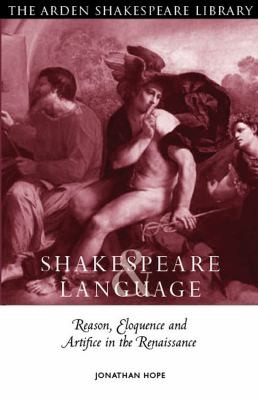
Shakespeare and Language: Reason, Eloquence and Artifice in the Renaissance
0
0
As an Amazon Associate and affiliate partner, Menrva Books earns from qualifying purchases. Learn more
Author Description
'Much drink may be said to be an equivocator with lechery: it makes him, and it mars him; it sets him on, and it takes him off; it persuades him, and disheartens him; makes him stand to, and not stand to: in conclusion, equivocates him in a sleep, and, giving him the lie, leaves him.' Porter, Macbeth, II i. Why would Elizabethan audiences find Shakespeare's Porter in Macbeth so funny? And what exactly is meant by the name the 'Weird' Sisters? Jonathan Hope, in a comprehensive and fascinating study, looks at how the concept of words meant something entirely different to Elizabethan audiences than they do to us today. In Shakespeare and Language: Reason, Eloquence and Artifice in the Renaissance, he traces the ideas about language that separate us from Shakespeare. Our understanding of 'words', and how they get their meanings, based on a stable spelling system and dictionary definitions, simply does not hold. Language in the Renaissance was speech rather than writing-for most writers at the time, a 'word' was by definition a collection of sounds, not letters-and the consequences of this run deep. They explain our culture's inability to appreciate Shakespeare's wordplay, and suggest that a rift opened up in the seventeenth century as language came to be regarded as essentially 'written'. The book also considers the visual iconography of language in the Renaissance, the influence of the rhetorical tradition, the extent to which Shakespeare's late style is driven by a desire to increase the subjective content of the text, and new ways of studying Shakespeare's language using computers. As such it will be of great interest to all serious students and teachers of Shakespeare. Despite the complexity of its subject matter, the book is accessibly written with an undergraduate readership in mind.--Bloomsbury Publishing.
Menrva's Summary
THE THESIS
This book investigates the fundamental differences between Renaissance and modern understandings of language, particularly as they pertain to Shakespeare. Jonathan Hope examines how Elizabethan audiences perceived words, meaning, and rhetoric, contrasting it with contemporary views shaped by stable spelling and dictionary definitions. The study argues that a significant shift occurred in the seventeenth century, moving from a speech-centric understanding of language to a writing-centric one, which impacts our ability to fully appreciate Shakespeare's linguistic artistry. It explores the visual and rhetorical traditions influencing Renaissance language, Shakespeare's late style, and computational methods for analyzing his works.
THE SCOPE MAP
- Analysis of the concept of 'words' as sound collections versus letter collections in the Renaissance.
- Exploration of the cultural rift that emerged as language became increasingly viewed as 'written'.
- Examination of the visual iconography of language during the Renaissance.
- Discussion of the influence of the classical rhetorical tradition on Shakespeare's language.
- Investigation into whether Shakespeare's late style aimed to increase the subjective content of his texts.
- Introduction to new computational methods for studying Shakespeare's language.
- Focus on the differing interpretations of humor and wordplay by Elizabethan audiences compared to modern ones.
THE AUTHORITY PERSPECTIVE
The book is characterized as a comprehensive and fascinating study that traces the ideas about language separating us from Shakespeare. It is noted for its accessibility, written with an undergraduate readership in mind despite the complexity of its subject matter. The work is expected to be of great interest to serious students and teachers of Shakespeare, offering new perspectives on his linguistic techniques and the cultural context of his era. The analysis delves into the historical evolution of language perception and its impact on literary interpretation.
Page Count:
272
Publication Date:
2010-01-01
ISBN-10:
1904271693
ISBN-13:
9781904271697
Non-Fiction
Literary Fiction
History
Literary Criticism
Linguistics
Shakespearean Studies
Community Tags
Similar Books