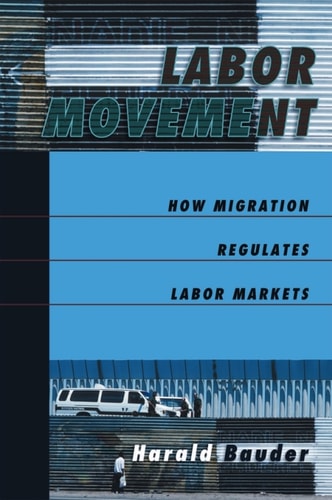
Labor Movement: How Migration Regulates Labor Markets
0
0
As an Amazon Associate and affiliate partner, Menrva Books earns from qualifying purchases. Learn more
Author Description
Throughout the industrialized world, international migrants serve as nannies, construction workers, gardeners and small-business entrepreneurs. Labor Movement suggests that the international migration of workers is necessary for the survival of industrialized economies. The book thus turns theconventional view of international migration on its head: it investigates how migration regulates labor markets, rather than labor markets shaping migration flows. Assuming a critical view of orthodox economic theory, the book illustrates how different legal, social and cultural strategies towardsinternational migrants are deployed and coordinated within the wider neo-liberal project to render migrants and immigrants vulnerable, pushing them into performing distinct economic roles and into subordinate labor market situations. Drawing on social theories associated with Pierre Bourdieu andother prominent thinkers, Labor Movement suggests that migration regulates labor markets through processes of social distinction, cultural judgement and the strategic deployment of citizenship. European and North American case studies illustrate how the labor of international migrants issystematically devalued and how popular discourse legitimates the demotion of migrants to subordinate labor. Engaging with various immigrant groups in different cities, including South Asian immigrants in Vancouver, foreigners and Spataussiedler in Berlin, and Mexican and Caribbean offshore workersin rural Ontario, the studies seek to unravel the complex web of regulatory labor market processes related to international migration. Recognizing and understanding these processes, Bauder argues, is an important step towards building effective activist strategies and for envisioning new roles formigrating workers and people. The book is a valuable resource to researchers and students in economics, ethnic and migration studies, geography, sociology, political science, and to frontline activists in Europe, North America and beyond.
Menrva's Summary
THE THESIS
This book investigates how international migration serves as a regulatory mechanism for labor markets within industrialized economies rather than merely responding to market demands. The author, Harald Bauder, utilizes a critical theoretical framework to challenge orthodox economic perspectives on migration. By drawing on the social theories of Pierre Bourdieu, the text argues that legal, social, and cultural strategies are systematically deployed to render migrant workers vulnerable and subordinate within the neo-liberal project.
THE SCOPE MAP
What You Will Find
- Analysis of labor market regulation through social distinction and cultural judgment.
- Comparative case studies of immigrant groups in Vancouver, Berlin, and rural Ontario.
- Examination of the strategic deployment of citizenship as a tool for labor devaluation.
- Theoretical synthesis of neo-liberal economic policy and migrant labor roles.
THE AUTHORITY PERSPECTIVE
Experts recognize this work as a significant contribution to the critical study of migration and labor economics. Readers frequently note the academic density of the prose, which is intended for researchers and students in the social sciences.
Page Count:
736
Publication Date:
2003-02-27
Publisher:
Oxford University Press
ISBN-10:
0199258279
ISBN-13:
9780199258277
Economics
Sociology
Security services
Labor Studies
Migration Studies
Legal System
Community Tags
Similar Books