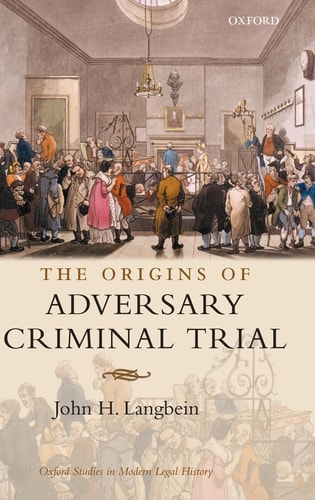
The Origins of Adversary Criminal Trial
0
0
As an Amazon Associate and affiliate partner, Menrva Books earns from qualifying purchases. Learn more
Author Description
The adversary system of trial, the defining feature of the Anglo-American legal procedure, developed late in English legal history. For centuries defendants were forbidden to have legal counsel, and lawyers seldom appeared for the prosecution either. Trial was meant to be an occasion for the defendant to answer the charges in person.The transformation from lawyer-free to lawyer-dominated criminal trial happened within the space of about a century, from the 1690's to the 1780's. This book explains how the lawyers captured the trial. In addition to conventional legal sources, Professor Langbein draws upon a rich vein of contemporary pamphlet accounts about trials in London's Old Bailey. The book also mines these novel sources to provide the first detailed account of the formation of the law of criminal evidence.Responding to menacing prosecutorial initiatives (including reward-seeking thief takers and crown witnesses induced to testify in order to save their own necks) the judges of the 1730's decided to allow the defendant to have counsel to cross-examine accusing witnesses. By restricting counsel to the work of examining and cross-examining witnesses, the judges intended that the accused would still need to respond in person to the charges against him. Professor Langbein shows how counsel manipulated the dynamics of adversary procedure to defeat the judges design, ultimately silencing the accused and transforming the very purpose of the criminal trial. Trial ceased to be an opportunity for the accused to speak, and instead became an occasion for defense counsel to test the prosecution case.
Menrva's Summary
THE THESIS
This book investigates the historical transformation of the English criminal trial from a lawyer-free proceeding to the modern adversary system dominated by legal counsel. Professor John H. Langbein, a distinguished legal historian, utilizes a combination of traditional legal records and contemporary pamphlet accounts from London's Old Bailey to reconstruct the procedural shifts of the 18th century. He argues that the introduction of defense counsel, initially intended by judges to assist in cross-examination, was manipulated by lawyers to fundamentally alter the trial's purpose and silence the accused.
THE SCOPE MAP
What You Will Find
- Analysis of the transition from lawyer-free to lawyer-dominated criminal trials between the 1690s and the 1780s.
- Examination of the formation of the law of criminal evidence through contemporary trial accounts.
- Case studies of prosecutorial initiatives, including the role of reward-seeking thief takers and crown witnesses.
- Investigation into the judicial intent behind allowing counsel and the subsequent subversion of that intent by defense attorneys.
THE AUTHORITY PERSPECTIVE
Legal scholars and historians frequently cite this work as a foundational text for understanding the evolution of Anglo-American criminal procedure. Experts highlight the author's meticulous use of primary source pamphlets to provide a granular view of courtroom dynamics that traditional legal records often obscure.
Page Count:
376
Publication Date:
2003-03-27
Publisher:
Oxford University Press
ISBN-10:
0199258880
ISBN-13:
9780199258888
History
Non-Fiction
Law
Legal History
Prosecution
Professional Career & Trade