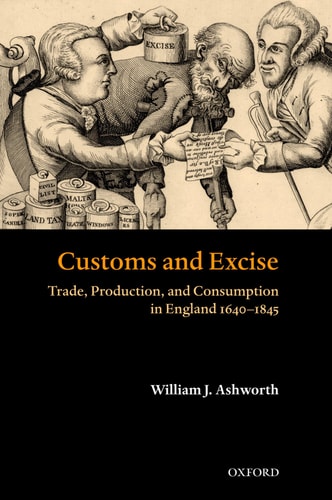
Customs and Excise: Trade, Production, and Consumption in England, 1640-1845
0
0
As an Amazon Associate and affiliate partner, Menrva Books earns from qualifying purchases. Learn more
Author Description
Ashworth traces the growth of customs and excise, and their integral role in shaping the framework of industrial England. He examines their influence on elements such as state power, technical advance, and the evolution of a consumer society. If there was a unique pathway of industrialization, it was less a distinct entrepreneurial and techno-centric culture, than one predominantly defined within an institutional framework spearheaded by the excise and a wall of tariffs.
Menrva's Summary
THE THESIS
This work investigates how the development of customs and excise systems functioned as the primary institutional framework for industrialization in England between 1640 and 1845. William J. Ashworth, a historian specializing in the history of science and technology, utilizes extensive archival research to challenge the traditional narrative that industrial progress was driven solely by entrepreneurial innovation. He argues that state-imposed tariffs and excise regulations were not merely fiscal measures but were central to the structural evolution of the British state and its consumer economy.
THE SCOPE MAP
What You Will Find
- Analysis of the administrative growth of the customs and excise bureaucracy.
- Examination of the relationship between state power and technical standardization.
- Historical data on trade policies and their impact on domestic production.
- Evaluation of how tariff walls shaped the emergence of a consumer-oriented society.
THE AUTHORITY PERSPECTIVE
Scholars recognize this text as a significant contribution to the economic history of the Industrial Revolution, particularly for its focus on institutional rather than purely technological drivers. Readers frequently note the academic density of the prose, which is tailored for researchers and students of economic history.
Page Count:
416
Publication Date:
2003-10-09
Publisher:
Oxford University Press
ISBN-10:
0199259216
ISBN-13:
9780199259212
Economics
History
Commerce
British History
Great Britain
Community Tags
Similar Books